
Dividing mixed fractions
Dividing mixed fractions is a skill that helps you tackle real-world problems, like splitting a recipe into smaller portions or dividing resources evenly. By converting mixed fractions into improper fractions and following a few simple steps, you can make even tricky divisions a breeze! Jump to the questions
Practise now
Worksheet preview and key skills
Worksheet preview
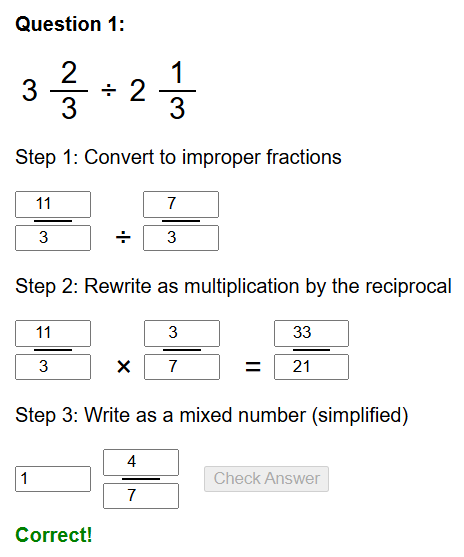
Practise dividing mixed fractions with this self-marking maths worksheet.
The interactive worksheet below generates questions, gives instant feedback, and lets students record their score.
What you’ll practise
- Converting mixed numbers to improper fractions first.
- Using the reciprocal of the second fraction.
- Multiplying numerators and denominators.
- Simplifying or converting the final answer where appropriate.
Use the interactive worksheet below, or read the Topic guide for the method and worked example.
Convert the mixed numbers to improper fractions, rewrite the division as multiplication by the reciprocal, and simplify the result. Enter your final answer as a mixed number in its simplest form.
Topic guide
What this worksheet practises
This worksheet provides practice on dividing mixed number fractions. Before you can divide fractions, they must be in their standard form. Attempting to divide the whole numbers and the fractions separately will almost always lead to the wrong answer.
Key method
The process combines two crucial fraction skills: converting to improper fractions, and the Keep-Change-Flip (KFC) method.
- First, convert any mixed numbers into improper fractions (top-heavy fractions).
- Once both numbers are improper fractions, apply the KFC rule: Keep the first fraction, Change ÷ to ×, and Flip the second fraction.
- Multiply the two top numbers together.
- Multiply the two bottom numbers together.
- Simplify your answer and, if required, convert it back into a mixed number.
Worked example
Calculate 2½ ÷ 1¼.
Step 1: Convert both to improper fractions.
2½ = 5/2.
1¼ = 5/4.
The calculation is now: 5/2 ÷ 5/4.
Step 2: Apply Keep-Change-Flip.
Keep 5/2. Change ÷ to ×. Flip 5/4 to 4/5.
5/2 × 4/5.
Step 3: Multiply tops and bottoms.
(5 × 4) / (2 × 5) = 20 / 10.
Step 4: Simplify.
20 ÷ 10 = 2.
The final answer is exactly 2.
Common mistakes to avoid
The most fatal error is trying to apply the KFC rule before converting the mixed numbers into improper fractions. For example, trying to flip 1¼ into 1&frac41;. This is mathematically meaningless. You must always convert to top-heavy fractions first.
How to check your answer
Division tells you "how many times does the second number fit into the first number". In our example, we are asking how many times 1¼ fits into 2½. Since 1¼ doubled is exactly 2½, it fits exactly 2 times. Logical checks like this can prevent major calculation errors.