
Adding fractions
Adding fractions is a skill you’ll use everywhere, from splitting a pizza with friends to calculating ingredients in a recipe. It’s all about finding common ground—literally, a common denominator—so you can combine the parts into a whole. Jump to the questions
Practise now
Worksheet preview and key skills
Worksheet preview
Practise adding fractions with this self-marking maths worksheet.
The interactive worksheet below generates questions, gives instant feedback, and lets students record their score.
What you’ll practise
- Finding a common denominator where needed.
- Rewriting fractions as equivalent fractions.
- Adding the numerators.
- Simplifying the final answer where possible.
Use the interactive worksheet below, or read the Topic guide for the method and worked example.
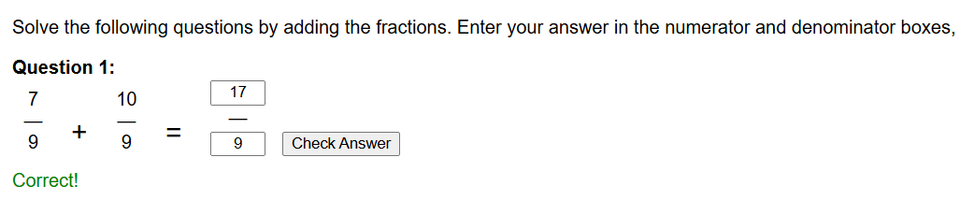
Solve the following questions by adding the fractions. Enter your answer in the numerator and denominator boxes.
Topic guide
What this worksheet practises
This worksheet provides practice on adding fractions with different denominators. This is a foundational arithmetic skill. You cannot simply add the top numbers and bottom numbers together; the fractions must represent the same-sized parts before they can be combined.
Key method
To add fractions with different denominators, you must first find a common denominator by creating equivalent fractions.
- Identify the lowest common multiple (LCM) of the two denominators. This will be your new common denominator.
- Multiply the numerator and denominator of the first fraction by the value needed to reach the common denominator.
- Do the same for the second fraction.
- Add the numerators together, keeping the common denominator the same.
- Simplify your final fraction if possible.
Worked example
Calculate 1/3 + 2/5
Step 1: Find a common denominator. The lowest common multiple of 3 and 5 is 15.
Step 2: Convert 1/3 into fifteenths. Multiply the top and bottom by 5.
1/3 = 5/15.
Step 3: Convert 2/5 into fifteenths. Multiply the top and bottom by 3.
2/5 = 6/15.
Step 4: Add the numerators together.
5/15 + 6/15 = 11/15.
Common mistakes to avoid
A frequent error is adding the numerators and adding the denominators directly (e.g. thinking 1/3 + 2/5 = 3/8). Denominators only dictate the size of the pieces, so they are never added together. Only the top numbers (how many pieces you have) are added once the pieces are the same size.
How to check your answer
Use estimation. If you are calculating 1/2 + 5/8, you know that 5/8 is more than a half. Therefore, a half plus something slightly larger than a half must be greater than a whole. If your answer is less than 1, you have made a calculation error.