
Adding and subtracting fractions with common denominators
Adding and subtracting fractions is a skill that pops up in real life more often than you think! Whether you're splitting a pizza with friends, measuring ingredients for a recipe, or working out how much time is left in a game, understanding how to combine or separate fractions makes these everyday tasks easier—and helps you avoid getting short-changed on that last slice of pizza! Jump to the questions
Practise now
Worksheet preview and key skills
Worksheet preview
Practise adding and subtracting fractions with common denominators with this self-marking maths worksheet.
The interactive worksheet below generates questions, gives instant feedback, and lets students record their score.
What you’ll practise
- Recognising that the denominators already match.
- Adding or subtracting the numerators.
- Keeping the denominator the same.
- Simplifying the final answer where possible.
Use the interactive worksheet below, or read the Topic guide for the method and worked example.
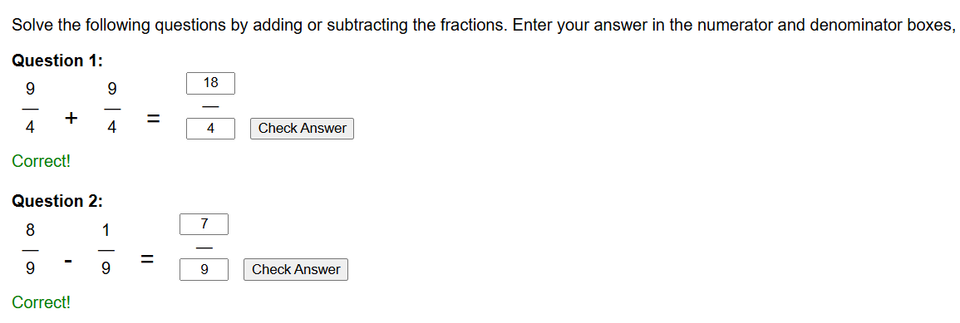
Solve the following questions by adding or subtracting the fractions. Enter your answer in the numerator and denominator boxes.
Topic guide
What this worksheet practises
This worksheet focuses on adding and subtracting fractions that already share the same denominator (the bottom number).
Key method
When the denominators are the same, the pieces you are adding or subtracting are the same size.
- Check that the denominators are identical.
- Add or subtract the numerators (the top numbers) together.
- Keep the denominator exactly the same.
- If your final fraction can be simplified, divide both the top and bottom by their highest common factor.
Worked example
Calculate 3/8 + 1/8
Step 1: Both fractions have a denominator of 8. We keep 8 as the denominator for our answer.
Step 2: Add the numerators together: 3 + 1 = 4.
Step 3: Write the new fraction: 4/8.
Step 4: Simplify the fraction. Both 4 and 8 can be divided by 4.
4 ÷ 4 = 1
8 ÷ 4 = 2
The final simplified answer is 1/2.
Common mistakes to avoid
The most frequent mistake is adding the denominators together. For example, calculating 3/8 + 1/8 as 4/16. The denominator tells you what kind of fraction it is (eighths), so three eighths plus one eighth equals four eighths, not four sixteenths.
Things to remember
Always read the question carefully to see if it asks for the fraction in its "simplest form". If it does, you must complete the final simplification step to earn full marks.