
Gradient between two points
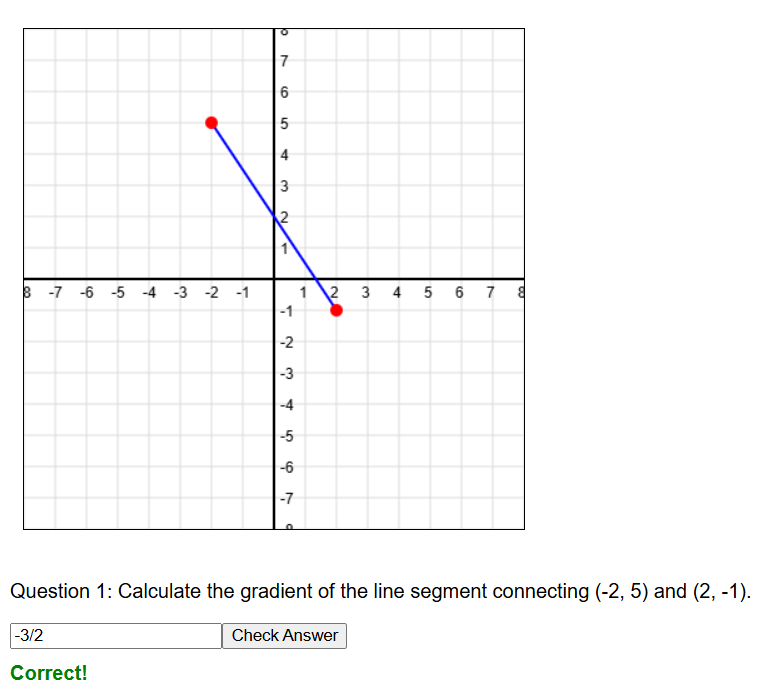
The gradient between two points tells us how steep a line is when connecting them. It's like figuring out how quickly you're climbing or descending a hill when moving from one spot to another. Gradients are everywhere—whether you're driving uphill, designing ramps, or analyzing trends in data! Jump to the questions
Practise now
Worksheet preview and key skills
Worksheet preview
Practise gradient between two points with this self-marking maths worksheet.
The interactive worksheet below generates questions, gives instant feedback, and lets students record their score.
What you’ll practise
- Finding the change in y.
- Finding the change in x.
- Using gradient = change in y / change in x.
- Interpreting positive, negative or zero gradients where relevant.
Use the interactive worksheet below, or read the Topic guide for the method and worked example.
Calculate the gradient of the line segment connecting the two points.
Topic guide
What this worksheet practises
This worksheet provides practice on calculating the exact gradient (steepness) of a straight line connecting two coordinate points. This is identical to the "finding-the-gradient" topic, reinforcing the core coordinate geometry formula.
Key method
The gradient formula is: Gradient (m) = (Change in y) ÷ (Change in x).
- Identify the coordinates of your two points: Point A (x₁, y₁) and Point B (x₂, y₂).
- Calculate the difference between the y-coordinates. This gives you the vertical "rise".
- Calculate the difference between the x-coordinates. This gives you the horizontal "run".
- Divide the y-difference by the x-difference. Be extremely careful with negative numbers during the subtraction.
Worked example
Find the gradient of the line connecting A(3, −1) and B(5, 7).
Step 1: Calculate the change in y.
y of point B minus y of point A = 7 − (−1) = 7 + 1 = 8.
Step 2: Calculate the change in x. Because we started with point B for the y's, we must start with point B for the x's.
x of point B minus x of point A = 5 − 3 = 2.
Step 3: Calculate the gradient.
Gradient (m) = 8 ÷ 2 = 4.
Common mistakes to avoid
The two most common errors are: 1) Dividing the change in x by the change in y (putting the run on top of the rise), and 2) Mixing up the order of the points halfway through. If you calculate (y₂ − y₁), you absolutely must calculate (x₂ − x₁). If you switch to (x₁ − x₂), your final answer will have the wrong sign.
Things to remember
If your line goes downwards from left to right, your gradient must be a negative number. Always do a quick visual check (or sketch the points) to ensure the sign of your calculated gradient matches the physical reality of the line.