
Circumference of a circle
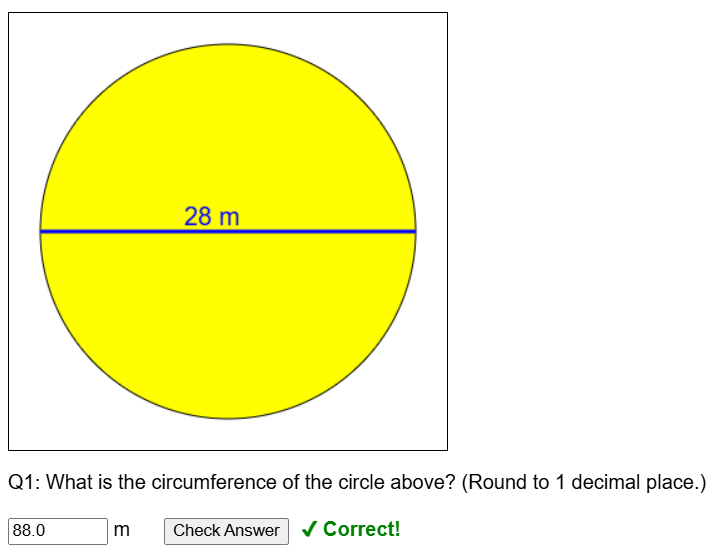
The circumference of a circle is the distance around its edge, much like the perimeter of a shape. You can think of it as the length of a circular path—like the track of a racecourse or the rim of a bicycle wheel. Jump to the questions
Practise now
Worksheet preview and key skills
Worksheet preview
Practise circumference of a circle with this self-marking maths worksheet.
The interactive worksheet below generates questions, gives instant feedback, and lets students record their score.
What you’ll practise
- Identifying the radius or diameter.
- Using C = πd or C = 2πr.
- Multiplying by π.
- Giving the answer with suitable length units.
Use the interactive worksheet below, or read the Topic guide for the method and worked example.
Calculate the circumference using the pi button on your calculator or alternatively use 3.142. Round to 1 decimal place.
Topic guide
What this worksheet practises
This worksheet provides practice on calculating the numerical circumference of a circle. The circumference is the distance all the way around the outside edge of the circle (its perimeter).
Key method
The formula to find the circumference is C = πd.
- Determine the diameter ('d'). If the question gives you the radius instead, you must double it first.
- Multiply the diameter by π using the π button on your calculator. If you don't have a scientific calculator, use 3.14 as an approximation.
- Round your final answer to the required degree of accuracy (usually 1 or 2 decimal places).
Worked example
Calculate the circumference of a circle with a diameter of 12 cm. Give your answer to 1 decimal place.
Step 1: Identify the diameter. Here, d = 12 cm.
Step 2: Use the formula C = πd.
C = π × 12
C = 37.69911...
Step 3: Round the answer to 1 decimal place. The second decimal digit is 9, so we round up.
C = 37.7 cm.
Common mistakes to avoid
A frequent error is using the radius instead of the diameter in the calculation. Always pause and ask yourself: "Do I have the line halfway across, or the line all the way across?" Another common pitfall is rounding too early in the calculation, which can distort your final answer.
How to check your answer
Since π is approximately 3, the circumference will always be roughly three times the diameter. If the diameter is 12, the answer should be a little more than 36. If your calculator shows something wildly different, you likely pushed the wrong button.