
Composite Functions
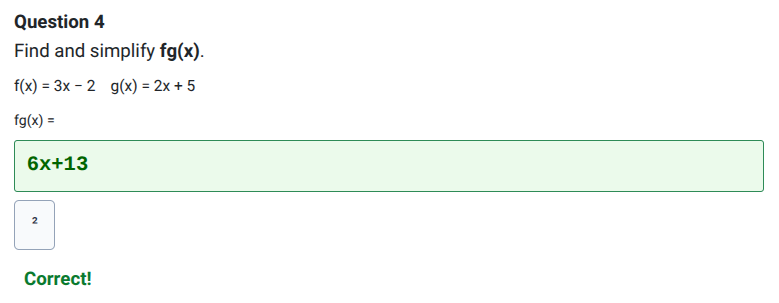
Practise composite functions with eight self-marking GCSE Higher questions. Work from right to left to evaluate and form fg(x), gf(x), repeated functions and three-function compositions, then solve an equation involving two different compositions. Jump to the questions
Practise now
Worksheet preview and key skills
Worksheet preview
This eight-question GCSE Higher worksheet builds from numerical compositions to algebraic compositions and equations.
You will use two and three functions, including linear and quadratic rules, and compare fg(x) with gf(x).
What you’ll practise
- evaluating fg(a), gf(a) and a repeated function;
- forming and simplifying composite functions;
- working through three functions from right to left;
- solving fg(x) = gf(x).
Use the interactive worksheet below, or read the Topic guide for the method and worked example.
Work from right to left: fg(x) means f(g(x)), not f(x) × g(x). Every numbered question is worth one mark.
Topic guide
What is a composite function?
A composite function uses the output of one function as the input of another. The notation fg(x) means f(g(x)): apply g first, then apply f. It does not mean f(x) multiplied by g(x).
A numerical example
Let f(x) = 2x + 3 and g(x) = x − 4. To find fg(5), first calculate g(5) = 1. Then use that output in f: f(1) = 5. Therefore fg(5) = 5.
Why order matters
Using the same functions, gf(5) means g(f(5)). First f(5) = 13, then g(13) = 9, so gf(5) = 9. In this example fg(5) and gf(5) are different. Always read a composition from right to left.
Composing a quadratic and a linear function
If f(x) = 3x − 1 and g(x) = x² + 2, then fg(x) = f(x² + 2) = 3(x² + 2) − 1 = 3x² + 5.
In the other order, gf(x) = g(3x − 1) = (3x − 1)² + 2. The whole linear expression must be squared, so brackets are important.
Three functions
For fgh(x), begin with h(x), put that result into g, then put the new result into f. Keep each substituted expression in brackets until you simplify.
Solving fg(x) = gf(x)
Let f(x) = 2x + 2 and g(x) = x² + 2. Then fg(x) = 2x² + 6, while gf(x) = (2x + 2)² + 2 = 4x² + 8x + 6. Equating them gives 2x² + 8x = 0. Factorising gives 2x(x + 4) = 0, hence x = 0 or x = −4.
Useful checks
- Start with the function nearest to x or the number.
- Use brackets when substituting one expression into another.
- Do not assume fg(x) and gf(x) are equal.
- Expand squared brackets carefully, including the middle term.