
Convert small numbers to standard form
Converting small numbers to standard form is a useful skill in science and engineering, where very tiny values often need to be written in a compact way. For example, the size of a cell or the thickness of a hair are easier to express using powers of 10. Standard form makes it easier to work with these small numbers in calculations and to compare them quickly. Jump to the questions
Practise now
Worksheet preview and key skills
Worksheet preview
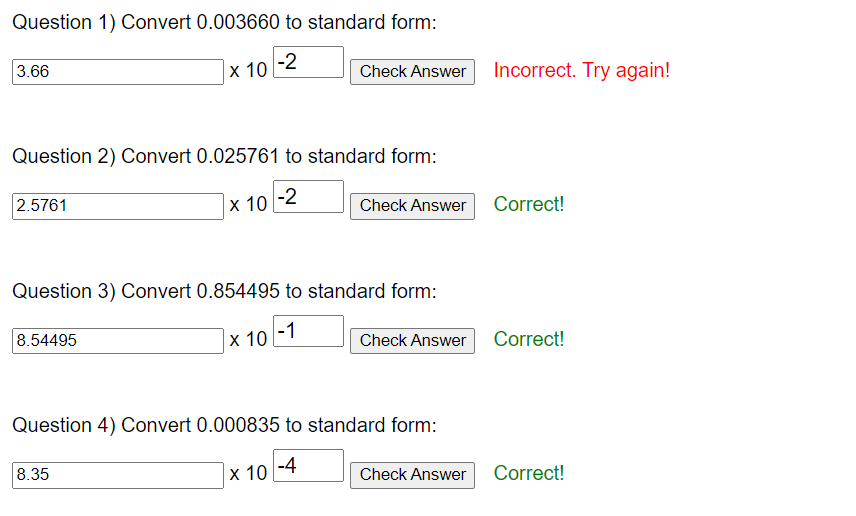
Practise converting small numbers to standard form with this self-marking maths worksheet.
The interactive worksheet below generates questions, gives instant feedback, and lets students record their score.
What you’ll practise
- Moving the decimal point to make a number between 1 and 10.
- Counting the power of 10.
- Using a negative power for small numbers.
- Writing the final answer in standard form.
Use the interactive worksheet below, or read the Topic guide for the method and worked example.
For each number, fill in the coefficient and the power of 10 in the boxes provided.
Topic guide
What this worksheet practises
This worksheet provides practice on converting very small decimal numbers into standard form. Writing tiny numbers (like the size of a microscopic cell) with lots of leading zeroes is prone to error. Standard form provides a neat, uniform way to display them.
Key method
A number in standard form is written as: A × 10n. For small numbers (less than 1), the power 'n' will always be negative.
- Scan the decimal from left to right to find the first non-zero digit.
- Place a decimal point immediately after this digit to create a number 'A' that is between 1 and 10.
- Count how many places the decimal point has moved from its original starting position to its new position.
- This count becomes your negative power.
Worked example
Write 0.000073 in standard form.
Step 1: Find the first non-zero digit (which is 7) and place the decimal point after it.
This gives us 7.3.
Step 2: Count the jumps the decimal point made.
It moved from 0.000073 to 7.3, which is a jump of 5 places to the right.
Step 3: Because the original number was small (less than 1), the power is negative.
The power is −5.
Step 4: Write the final answer.
7.3 × 10⁻⁵.
Common mistakes to avoid
A frequent mistake is writing a positive power instead of a negative one. Remember: large numbers have positive powers, small decimal numbers have negative powers. Another error is making 'A' too small, for example writing 0.73 × 10⁻⁴. The front number must always be 1 or greater.
How to check your answer
A helpful shortcut to check your work is that the negative power usually matches the total number of zeroes at the front of the number, including the zero before the decimal point. 0.000073 has five zeroes in front of the 7, matching the power of −5 perfectly.