
Compound area
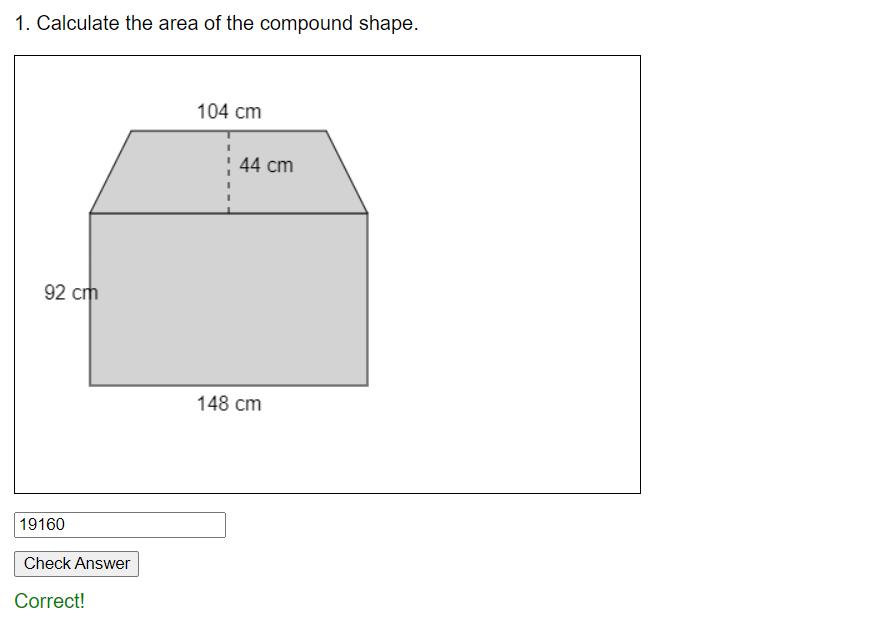
Understanding how to calculate the area of compound shapes is important in real-world situations like designing a park, building a garden, or even arranging furniture in a room. By breaking down complex shapes into simpler ones like rectangles, triangles, or circles, you can find the total area with ease—an essential skill in architecture, engineering, and everyday problem-solving. Jump to the questions
Practise now
Worksheet preview and key skills
Worksheet preview
Practise compound area with this self-marking maths worksheet.
The interactive worksheet below generates questions, gives instant feedback, and lets students record their score.
What you’ll practise
- Splitting a compound shape into simpler shapes.
- Finding missing side lengths where needed.
- Adding or subtracting areas carefully.
- Giving the final area in square units.
Use the interactive worksheet below, or read the Topic guide for the method and worked example.
Round all answers to the nearest whole number. For relevant questions either use the pi button on your calculator or use 3.142 instead.
Topic guide
What this worksheet practises
This worksheet focuses on calculating the area of compound shapes. A compound shape (or composite shape) is simply a shape made up of two or more basic geometric figures, such as rectangles and triangles joined together.
Key method
To find the total area, you must split the complex shape into simpler parts that you already know how to calculate.
- Draw a straight line across the shape to split it into two or more distinct rectangles or triangles.
- Use the given side lengths to deduce any missing side lengths required for your new, smaller shapes.
- Calculate the area of each individual shape separately.
- Add all the individual areas together to find the total compound area.
Worked example
Find the area of an L-shape that can be split into a 5cm by 2cm rectangle and a 3cm by 4cm rectangle.
Step 1: Identify the split. The shape is now Rectangle A and Rectangle B.
Step 2: Calculate the area of Rectangle A.
Area A = 5 × 2 = 10 cm².
Step 3: Calculate the area of Rectangle B.
Area B = 3 × 4 = 12 cm².
Step 4: Add the areas together.
Total Area = 10 + 12 = 22 cm².
Common mistakes to avoid
A common mistake is multiplying all the exterior lengths together indiscriminately. You must calculate the individual areas first. Another frequent trap is forgetting to deduce missing lengths; you often have to subtract a shorter side from a longer side to find the dimension of one of your split rectangles.
Things to remember
There is usually more than one correct way to split a compound shape. Whether you split an L-shape vertically or horizontally, the total final area will always be exactly the same.