
Multiplying in standard form
Multiplying in standard form is a useful way to handle very large or very small numbers, especially in fields like astronomy or chemistry. By expressing numbers as powers of ten, it simplifies calculations and helps make sense of extreme values in the real world, such as distances between planets or the size of microscopic organisms. Jump to the questions
Practise now
Worksheet preview and key skills
Worksheet preview
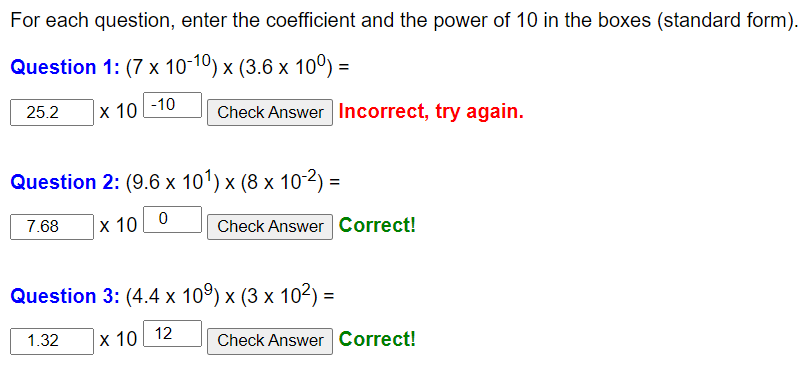
Practise multiplying in standard form with this self-marking maths worksheet.
The interactive worksheet below generates questions, gives instant feedback, and lets students record their score.
What you’ll practise
- Multiplying the decimal parts.
- Using index laws to multiply the powers of 10.
- Adjusting the answer so it is in standard form.
- Checking that the first number is between 1 and 10.
Use the interactive worksheet below, or read the Topic guide for the method and worked example.
For each question, enter the coefficient and the power of 10 in the boxes (standard form).
Topic guide
What this worksheet practises
This worksheet provides practice on multiplying two numbers that are written in Standard Form (scientific notation). This relies heavily on your understanding of index laws and decimal multiplication.
Key method
You can split the multiplication into two distinct parts: the front numbers and the powers of 10.
- Take the two front numbers (the decimals between 1 and 10) and multiply them together.
- Take the two "powers of 10" parts and multiply them together. According to the index laws, when you multiply powers with the same base (10), you add the index numbers.
- Combine these two new parts back into the standard form structure (Front Number × 10ⁿ).
- Crucial Step: Check if your new front number has become 10 or larger. If it has, you must adjust the decimal point and the power to fix the standard form.
Worked example
Calculate (3 × 10&sup4;) × (4 × 10&sup5;). Give your answer in standard form.
Step 1: Multiply the front numbers.
3 × 4 = 12.
Step 2: Multiply the powers of 10 (by adding the indices).
10&sup4; × 10&sup5; = 10&sup9;.
Step 3: Combine them.
12 × 10&sup9;.
Step 4: Fix the standard form. The front number (12) is not between 1 and 10. We must divide it by 10 to make it 1.2. Because we made the front number 10 times smaller, we must make the power 10 times bigger (add 1 to the index) to balance it out.
The final correct answer is 1.2 × 10¹&sup0;.
Common mistakes to avoid
The two most common errors are: 1) Multiplying the index powers together instead of adding them (e.g. writing 10²&sup0; instead of 10&sup9;), and 2) Forgetting to do the final "fix" at the end if the front number exceeds 10.
How to check your answer
If you have to adjust your final answer because the front number was too large, your final power should always be exactly 1 larger than the sum of the original two powers. In our example, the original powers were 4 and 5 (sum = 9). Our final adjusted power was 10. This indicates the adjustment was done correctly.