
Dividing in standard form
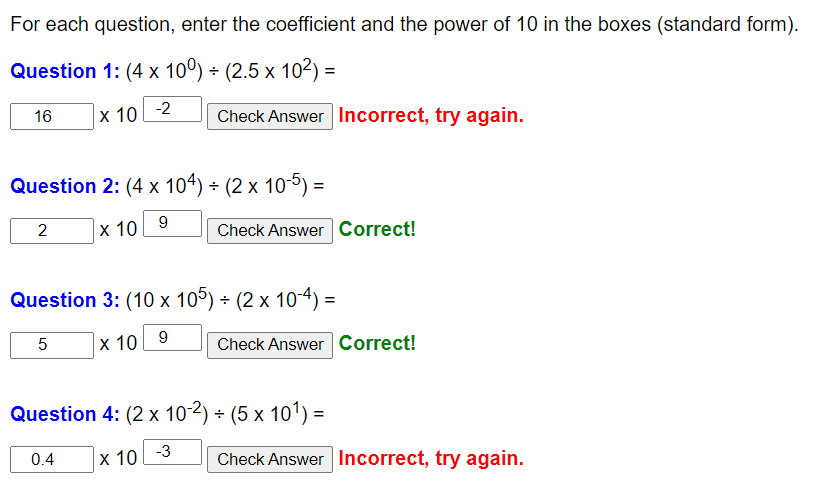
Dividing numbers in standard form is a useful skill in science and mathematics, especially when working with very large or very small numbers. It's commonly used in areas like astronomy, physics, and engineering, where quantities can vary widely in scale. By expressing numbers in standard form, complex divisions become much simpler to handle, allowing for easier calculations and comparisons. Jump to the questions
Practise now
Worksheet preview and key skills
Worksheet preview
Practise dividing in standard form with this self-marking maths worksheet.
The interactive worksheet below generates questions, gives instant feedback, and lets students record their score.
What you’ll practise
- Dividing the decimal parts.
- Using index laws to divide the powers of 10.
- Adjusting the answer so it is in standard form.
- Checking that the first number is between 1 and 10.
Use the interactive worksheet below, or read the Topic guide for the method and worked example.
For each question, enter the coefficient and the power of 10 in the boxes (standard form).
Topic guide
What this worksheet practises
This worksheet focuses on dividing numbers that are written in standard form. This is a common requirement in science when dealing with very large or very small scales, such as finding the speed of light or calculating population densities.
Key method
When dividing in standard form, you split the calculation into two completely separate parts: the ordinary numbers and the powers of 10.
- First, divide the ordinary numbers at the front.
- Second, use the laws of indices to divide the powers of 10. (When dividing terms with the same base, you subtract the powers).
- Combine these two results back together.
- Crucially, check if your final answer is still in proper standard form. The front number must be between 1 and 10. If it isn't, you must adjust it.
Worked example
Calculate (8 × 10&sup8;) ÷ (2 × 10³).
Step 1: Divide the front numbers.
8 ÷ 2 = 4.
Step 2: Divide the powers of 10 by subtracting the indices.
10&sup8; ÷ 10³ = 10(8 − 3) = 10&sup5;.
Step 3: Combine them.
4 × 10&sup5;.
Step 4: Check the format. 4 is between 1 and 10, so the standard form is correct.
Common mistakes to avoid
The biggest pitfall occurs when the front number calculation results in a decimal smaller than 1 (e.g. 0.5). You cannot leave an answer like 0.5 × 10&sup6;. You must make the 0.5 ten times bigger (becoming 5), and to balance this, make the power ten times smaller (becoming 10&sup5;), resulting in 5 × 10&sup5;.
How to check your answer
If the numbers are relatively small, convert them to ordinary numbers, perform the division, and convert back. For example, 800,000,000 ÷ 2,000 = 400,000, which is indeed 4 × 10&sup5;.