
Converting between miles and kilometres
Converting between miles and kilometers is essential for travel, navigation, and understanding distances in different countries. While the U.S. and the U.K. often use miles, most of the world measures distances in kilometers. Knowing how to switch between the two—using the conversion 5 miles ≈ 8 km—can help you read maps, plan trips, and compare distances easily! Jump to the questions
Practise now
Worksheet preview and key skills
Worksheet preview
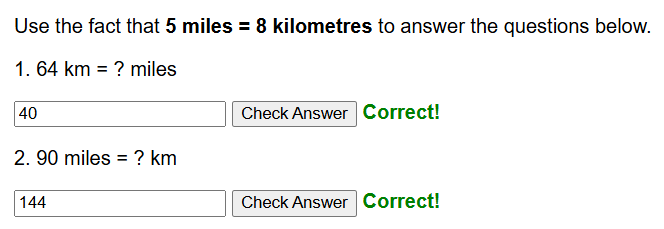
Practise converting between miles and kilometres with this self-marking maths worksheet.
The interactive worksheet below generates questions, gives instant feedback, and lets students record their score.
What you’ll practise
- Using the given miles-to-kilometres conversion.
- Multiplying or dividing by the conversion factor.
- Choosing the correct direction of conversion.
- Rounding the answer where required.
Use the interactive worksheet below, or read the Topic guide for the method and worked example.
Use the fact that 5 miles = 8 kilometres to answer the questions below.
Topic guide
What this worksheet practises
This worksheet focuses on converting distances between miles and kilometres. While most of the world uses the metric system (kilometres), the UK still heavily uses the imperial system (miles) for road distances. Knowing how to convert between the two is a necessary real-world skill and a common exam question.
Key method
To convert between miles and kilometres, you need to memorise a standard conversion ratio.
- The standard approximation is: 5 miles ≈ 8 kilometres.
- To convert miles to kilometres, divide by 5 and multiply by 8.
- To convert kilometres to miles, divide by 8 and multiply by 5.
- Alternatively, you can remember that 1 mile ≈ 1.6 km, and multiply or divide by 1.6 depending on the direction.
Worked example
A road sign says Paris is 40 kilometres away. Convert this distance into miles.
Step 1: Identify the direction of the conversion. We are going from kilometres to miles.
Step 2: Use the ratio 8 km = 5 miles. We need to find how many '8s' go into 40, and scale up the '5s'.
40 ÷ 8 = 5.
Step 3: Multiply this factor by 5 miles.
5 × 5 = 25.
The distance is 25 miles.
Common mistakes to avoid
The most common mistake is multiplying when you should divide, or using the ratio backwards (e.g. thinking 8 miles = 5 km). A simple trick is to remember that a kilometre is shorter than a mile. Therefore, for the same stretch of road, the number of kilometres will always be larger than the number of miles.
How to check your answer
Always perform a quick logic check using the rule above. In our example, we converted 40 km into 25 miles. The number of miles (25) is smaller than the number of kilometres (40), which matches reality. If you had accidentally got an answer of 64 miles, you would immediately know it was wrong.