
Converting fractions to decimals
Knowing how to convert fractions to decimals is super useful in everyday life — whether you’re measuring ingredients in a recipe, comparing prices, or calculating discounts. It helps you switch between different number formats so you can make quicker and clearer decisions. Jump to the questions
Practise now
Worksheet preview and key skills
Worksheet preview
Practise converting fractions to decimals with this self-marking maths worksheet.
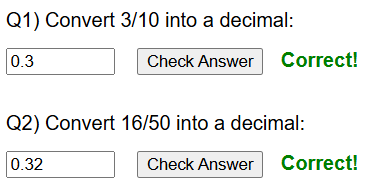
The interactive worksheet below generates questions, gives instant feedback, and lets students record their score.
What you’ll practise
- Dividing the numerator by the denominator.
- Recognising common fraction-decimal equivalents.
- Writing terminating decimals where possible.
- Using decimal notation accurately.
Use the interactive worksheet below, or read the Topic guide for the method and worked example.
Topic guide
What this worksheet practises
This worksheet focuses on converting fractions into decimals. A fraction is simply a division that hasn't been completed yet. Converting it to a decimal allows you to compare different sizes easily and enter the value into a calculator.
Key method
The line in a fraction literally means "divided by". To convert a fraction to a decimal, you perform that division.
- Identify the numerator (top number) and the denominator (bottom number).
- Set up a division calculation: numerator ÷ denominator.
- Use the bus stop method (short division). You will usually need to add a decimal point and some zeroes to the numerator to complete the division.
- If the division stops leaving a remainder, you have a terminating decimal. If a pattern of digits repeats forever, you have a recurring decimal.
Worked example
Convert 3/8 into a decimal.
Step 1: Set up the division: 3 ÷ 8.
Step 2: Use the bus stop method. 8 into 3 doesn't go, so write 0 and a decimal point. Carry the 3 over to a zero (making 30).
Step 3: 8 into 30 goes 3 times, remainder 6. Carry the 6 to the next zero (making 60).
Step 4: 8 into 60 goes 7 times, remainder 4. Carry the 4 to the next zero (making 40).
Step 5: 8 into 40 goes exactly 5 times.
The decimal is 0.375.
Common mistakes to avoid
The most common mistake is dividing the bottom number by the top number because it feels "easier" to divide the larger number by the smaller one. For example, calculating 8 ÷ 3 instead of 3 ÷ 8. The numerator must always go inside the bus stop.
How to check your answer
If the fraction is "proper" (the top number is smaller than the bottom), your decimal answer must start with "0.". If it starts with a whole number like 1 or 2, you have performed the division upside down.