
Rounding to the nearest 1000
Imagine you're at a concert with thousands of people — you don’t need to know the exact number, just a good estimate! Rounding to the nearest 1000 helps you quickly make sense of large numbers in real life, like populations, distances, or prices, without needing a calculator. Jump to the questions
Practise now
Worksheet preview and key skills
Worksheet preview
Practise rounding to the nearest 1000 with this self-marking maths worksheet.
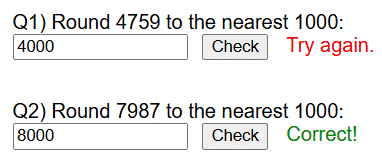
The interactive worksheet below generates questions, gives instant feedback, and lets students record their score.
What you’ll practise
- Identifying the thousands place.
- Looking at the hundreds digit.
- Deciding whether to round up or keep the thousands digit the same.
- Writing the rounded number with the correct zeros.
Use the interactive worksheet below, or read the Topic guide for the method and worked example.
Round each number to the nearest 1000.
Topic guide
What this worksheet practises
This worksheet focuses on rounding large numbers to the nearest thousand. This is a very common way to estimate large crowds, distances, or sums of money where exact precision isn't necessary. It essentially asks: "Is this number closer to the 1000 below it, or the 1000 above it?".
Key method
You must locate the thousands column and use the hundreds column to make your decision.
- Identify the digit in the thousands column. This is your target digit. (Remember the order from the right: Units, Tens, Hundreds, Thousands).
- Look at the digit immediately to its right, which will be the hundreds column. This is your "decider".
- If the decider is 5 or more (500 to 999), round the thousands digit up to the next thousand.
- If the decider is 4 or less (0 to 499), keep the thousands digit the same (rounding down).
- Replace the hundreds, tens, and units digits with three placeholder zeroes.
Worked example
Round 24,738 to the nearest 1000.
Step 1: Find the thousands column. It is the 4.
Step 2: Look at the decider (the hundreds column). It is a 7.
Step 3: Because 7 is five or more, we round the 4 up to a 5.
Step 4: The number starts with 25. Replace the 738 with three zeroes.
The final answer is 25,000.
Common mistakes to avoid
The most catastrophic mistake is forgetting the placeholder zeroes. A student might correctly round the 4 up to a 5, but then just write down "25" as the final answer. 24,738 is roughly twenty-five thousand, not twenty-five. You must include the three zeroes at the end.
Things to remember
The numbers "in front" of the thousands column (like the 2 in the twenty-thousands column above) usually stay exactly the same. The only exception is if your thousands digit is a 9 and it gets rounded up to a 10. For example, 39,600 rounded to the nearest thousand becomes 40,000.