
Rounding to the nearest hundred
Rounding to the nearest 100 is a useful way to estimate large numbers quickly — whether you're checking prices while shopping, estimating distances on a road trip, or simplifying numbers in a maths problem. It helps you get close enough to the answer without needing to be exact. Jump to the questions
Practise now
Worksheet preview and key skills
Worksheet preview
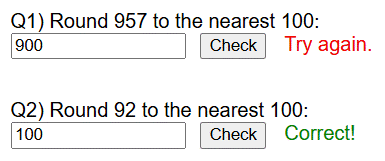
Practise rounding to the nearest hundred with this self-marking maths worksheet.
The interactive worksheet below generates questions, gives instant feedback, and lets students record their score.
What you’ll practise
- Identifying the hundreds place.
- Looking at the tens digit.
- Deciding whether to round up or keep the hundreds digit the same.
- Writing the rounded number with the correct zeros.
Use the interactive worksheet below, or read the Topic guide for the method and worked example.
Round each number to the nearest 100.
Topic guide
What this worksheet practises
This worksheet provides practice on rounding numbers to the nearest hundred. This is a very common everyday estimation skill. It essentially asks: "Is this number closer to the hundred below it, or the hundred above it?".
Key method
You must locate the hundreds column and use the tens column to make your decision.
- Identify the digit in the hundreds column. This is your target digit. (Remember the order from the right: Units, Tens, Hundreds).
- Look at the digit immediately to its right, which will be the tens column. This is your "decider".
- If the decider is 5 or more (50 to 99), round the hundreds digit up to the next hundred.
- If the decider is 4 or less (0 to 49), keep the hundreds digit the same (rounding down).
- Replace both the tens and units digits with two placeholder zeroes.
Worked example
Round 8,462 to the nearest 100.
Step 1: Find the hundreds column. It is the 4.
Step 2: Look at the decider (the tens column). It is a 6.
Step 3: Because 6 is five or more, we round the 4 up to a 5.
Step 4: The number now begins 85. Replace the 62 with two zeroes.
The final answer is 8,500.
Common mistakes to avoid
The most common mistake is getting distracted by the units column. In the example 8,462, a student might look at the 2 at the end, decide "2 is less than 5", and incorrectly round down to 8,400. The units column is completely irrelevant. You only ever look at the single digit immediately next to your target (the tens column).
How to check your answer
Look at the last two digits of your final answer. If you are rounding to the nearest hundred, your answer must always end in exactly two zeroes (e.g. 300, 1500, 26700).