
Converting smaller numbers in standard form to ordinary
Converting small numbers from standard form to ordinary numbers is an essential skill in science and mathematics, especially when dealing with very tiny measurements like cell sizes or distances in space. Standard form helps us write these numbers compactly, and converting them back to ordinary numbers allows us to understand their real-world size. Jump to the questions
Practise now
Worksheet preview and key skills
Worksheet preview
Practise converting smaller numbers in standard form to ordinary with this self-marking maths worksheet.
The interactive worksheet below generates questions, gives instant feedback, and lets students record their score.
What you’ll practise
- Reading the negative power of 10.
- Moving the decimal point to the left.
- Adding zeros where needed.
- Writing the ordinary decimal accurately.
Use the interactive worksheet below, or read the Topic guide for the method and worked example.
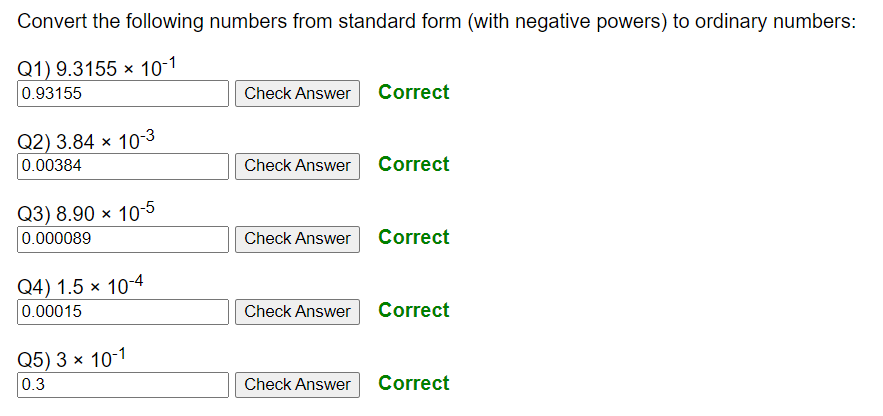
Convert the following numbers from standard form (with negative powers) to ordinary numbers:
Topic guide
What this worksheet practises
This worksheet provides practice on converting very small numbers written in standard form back into ordinary decimal numbers. You will frequently see standard form with negative powers in science when measuring things like the width of a hair or the mass of an atom.
Key method
Standard form for small numbers has a negative power. This negative power tells you how many places the decimal point needs to move to the left.
- Look at the negative power on the 10.
- Move the decimal point that many places to the left.
- You will run out of digits immediately, so fill the empty jumps with zeroes.
- Ensure your final number starts with "0."
Worked example
Write 3.8 × 10⁻⁴ as an ordinary number.
Step 1: Identify the power. It is −4, so move the point 4 places to the left.
Step 2: The first jump takes the point past the 3 (0.38). We need 3 more jumps.
Step 3: Fill those 3 extra jumps with zeroes.
0.00038
The ordinary number is 0.00038.
Common mistakes to avoid
A common mistake is drawing exactly 4 zeroes after the decimal point, resulting in 0.000038. The power of −4 does not mean "draw 4 zeroes after the point". It means move the point 4 times. Since one jump is needed to get past the '3', only 3 jumps are left for zeroes.
How to check your answer
There is a very reliable visual shortcut: the negative power usually equals the total number of zeroes at the front of the number, including the zero before the decimal point. In our answer 0.00038, there are exactly four zeroes in total. This matches the power of −4, so we know it's correct.