
Decimals to fractions (simplest form)
When you buy something for £2.75, that decimal actually hides a fraction—because money, measurements, and even time can all be expressed in parts of a whole. Learning to convert decimals to fractions (and then simplify them) helps you see the exact relationship between numbers, whether you’re dealing with money, recipes, or data in science. Jump to the questions
Practise now
Worksheet preview and key skills
Worksheet preview
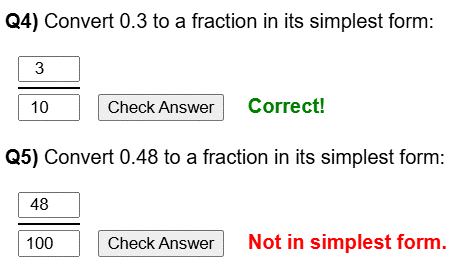
Practise converting decimals to fractions in simplest form with this self-marking maths worksheet.
The interactive worksheet below generates questions, gives instant feedback, and lets students record their score.
What you’ll practise
- Using place value to write the decimal as a fraction.
- Choosing tenths, hundredths or thousandths where needed.
- Simplifying the fraction.
- Writing the answer in simplest form.
Use the interactive worksheet below, or read the Topic guide for the method and worked example.
Topic guide
What this worksheet practises
This worksheet provides practice on converting decimals into fractions and then simplifying them. Understanding place value is the key to this conversion. Converting a decimal to a fraction is often the easiest way to perform complex multiplications or divisions without a calculator.
Key method
To convert a decimal to a fraction, you must use the place value of the final digit.
- Look at the last digit of the decimal. Does it fall in the tenths, hundredths, or thousandths column?
- Write the entire number (without the decimal point) as the numerator (the top).
- Write the place value of the final column as the denominator (the bottom). For example, if it ends in the hundredths column, put it over 100.
- Finally, simplify the fraction by finding the highest common factor of the top and bottom numbers.
Worked example
Convert 0.45 into a fraction in its simplest form.
Step 1: Identify the place value. The '5' is in the hundredths column.
Step 2: Write the number over 100.
45 / 100
Step 3: Simplify the fraction. Both numbers end in a 5 or a 0, so they are divisible by 5.
45 ÷ 5 = 9
100 ÷ 5 = 20
Step 4: Check if 9/20 can be simplified further. It cannot.
The simplest fraction is 9/20.
Common mistakes to avoid
A frequent mistake is putting every decimal over 100, regardless of its length. For example, converting 0.3 to 3/100, instead of 3/10. You must always use the place value of the last digit. Another common error is forgetting to cancel the fraction down to its simplest form.
How to check your answer
You can quickly check your fraction by performing a rough division. If your answer is 9/20, you know that 10/20 is exactly half (0.5). Because 9 is slightly less than 10, the decimal must be slightly less than 0.5. Since the original decimal was 0.45, your answer makes sense.