
Ordering decimals worksheet
When you’re shopping online or comparing prices in a café, you’re often dealing with decimals — like £2.75 versus £2.57. Being able to order decimals helps you quickly spot the better deal and avoid mistakes with money. Jump to the questions
Practise now
Worksheet preview and key skills
Worksheet preview
Practise ordering decimals with this self-marking maths worksheet.
The interactive worksheet below generates questions, gives instant feedback, and lets students record their score.
What you’ll practise
- Comparing decimal digits place by place.
- Using tenths, hundredths and thousandths.
- Ordering decimals from smallest to largest or largest to smallest.
- Treating missing decimal places carefully.
Use the interactive worksheet below, or read the Topic guide for the method and worked example.
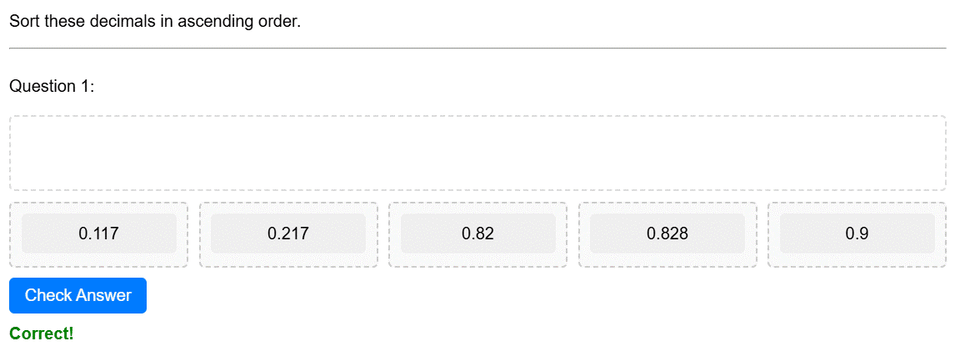
Sort these decimals in ascending order.
Topic guide
What this worksheet practises
This worksheet focuses on ordering a list of decimal numbers from smallest to largest. While it seems simple, decimals are specifically designed to trick your brain if you just look at the length of the number.
Key method
The safest and most reliable method is to make all the numbers the exact same length.
- Write all the numbers in a vertical column, perfectly lining up the decimal points.
- Find the longest decimal number in the list.
- Add "placeholder" zeroes to the end of all the shorter decimals until they all have the same number of digits after the decimal point.
- Now, ignoring the zero at the front, simply read the numbers from top to bottom as if they were normal whole numbers, and place them in order.
Worked example
Put these in size order: 0.35, 0.4, 0.305, 0.04.
Step 1: Line them up vertically.
0.35
0.4
0.305
0.04
Step 2: Add placeholder zeroes so they all have three digits after the point.
0.350
0.400
0.305
0.040
Step 3: Read them as whole numbers (350, 400, 305, 40). Place them in order.
Smallest: 0.040 (40)
Next: 0.305 (305)
Next: 0.350 (350)
Largest: 0.400 (400)
The final ordered list (without the extra zeroes) is: 0.04, 0.305, 0.35, 0.4.
Common mistakes to avoid
The most common mistake is assuming that "longer means bigger". A student might look at 0.305 and 0.4, and assume 0.305 is larger because "305 is bigger than 4". Adding the placeholder zeroes immediately reveals that it is actually 305 versus 400.
Things to remember
If the numbers have different integers before the decimal point (e.g. 2.5 and 1.98), you don't even need to look at the decimals to know which is bigger. Always compare the whole numbers first.