
Stem and leaf diagrams
Stem and leaf diagrams are a handy way to organise numbers so you can quickly spot patterns. They’re a bit like tidying up your messy bedroom floor—suddenly you can see what’s really there! Jump to the questions
Practise now
Worksheet preview and key skills
Worksheet preview
Practise stem-and-leaf diagrams with this self-marking maths worksheet.
The interactive worksheet below generates questions, gives instant feedback, and lets students record their score.
What you’ll practise
- Reading values from a stem-and-leaf diagram.
- Using the key correctly.
- Ordering or interpreting the data.
- Finding averages or spread from the diagram where relevant.
Use the interactive worksheet below, or read the Topic guide for the method and worked example.
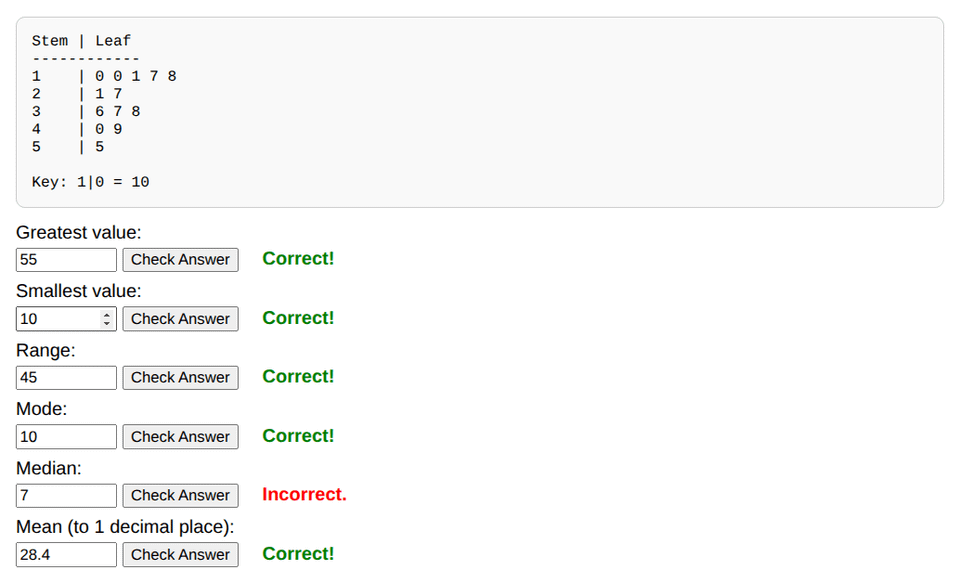
Calculate the statistical properties of the data presented in the stem-and-leaf diagrams below.
Topic guide
What this worksheet practises
This worksheet provides practice on reading, drawing, and finding averages from a Stem and Leaf diagram. This diagram is a clever way of sorting raw data into order without losing any of the original numbers.
Key method
The diagram splits every number into two parts: a "Stem" (the first part of the number) and a "Leaf" (the last single digit of the number).
- Reading it: A stem of '4' and a leaf of '2' usually means the number 42. You must always check the Key to be sure (sometimes 4|2 means 4.2).
- Drawing it: The "Leaves" must be written in strict numerical order going outwards. They must also line up perfectly in neat, equally-spaced columns so you can see the shape of the data.
- Finding the Median: Count the total number of leaves to find out how many pieces of data there are. Find the middle leaf by crossing off the smallest and largest until you meet in the middle. Be careful to jump to the next row when crossing off.
Worked example
A diagram has a row that looks like this:
3 | 1 4 4 7 9
The key says 3|1 means 31.
1) Write out the numbers in this row.
2) What is the mode of this row?
Example 1:
The stem is 3 for all of them. The leaves are 1, 4, 4, 7, 9.
The numbers are: 31, 34, 34, 37, 39.
Example 2: (The mode is the most common number).
Look at the leaves. The leaf '4' appears twice.
The mode is 34 (not just 4).
Common mistakes to avoid
When asked for the mode, median, or range, the most common mistake is writing down just the "Leaf" instead of the whole number. In the example above, stating the mode is "4" is wrong because the actual piece of data was 34.
Things to remember
A stem and leaf diagram is not finished unless it has a Key. If you are asked to draw one from scratch in an exam, forgetting to add a key (e.g., "Key: 2 | 5 means 25") will lose you a mark.