
Direct proportion to the cube
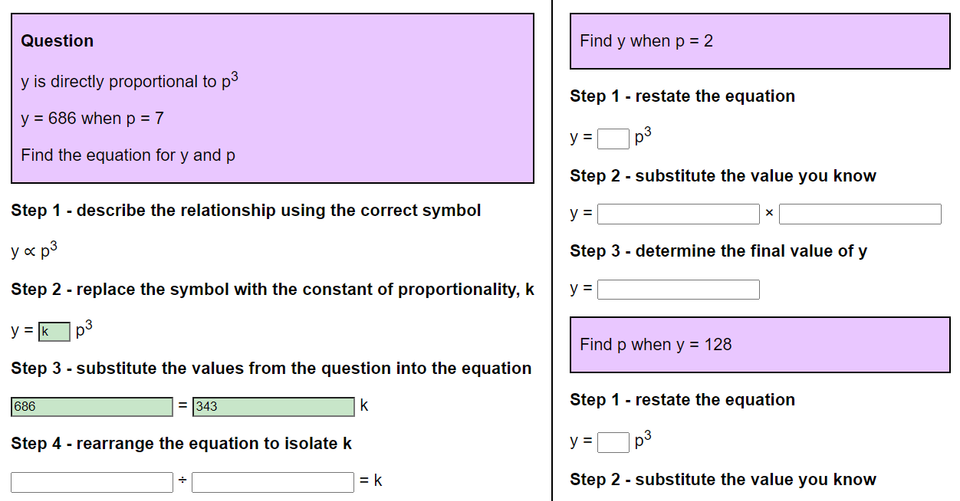
Direct proportion to the cube is when one quantity increases or decreases as the cube of another. This relationship often appears in physics, such as when calculating the volume of a sphere, which is directly proportional to the cube of its radius. Jump to the questions
Practise now
Worksheet preview and key skills
Worksheet preview
Practise direct proportion to the cube with this self-marking maths worksheet.
The interactive worksheet below generates questions, gives instant feedback, and lets students record their score.
What you’ll practise
- Recognising that one quantity is directly proportional to the cube of another.
- Writing a relationship such as y ∝ x³ or y = kx³.
- Finding the constant of proportionality.
- Substituting values to find a missing quantity.
Use the interactive worksheet below, or read the Topic guide for the method and worked example.
Topic guide
What this worksheet practises
This worksheet focuses on direct proportion to the cube of a number. In standard direct proportion, if one variable doubles, the other doubles. When proportion is linked to a cube, a small increase in one variable causes a massive, exponential increase in the other.
Key method
To solve these problems, you must set up an algebraic equation involving a constant of proportionality, 'k'.
- Write the proportionality statement: y ∝ x³.
- Convert this into an equation by adding 'k': y = kx³.
- Substitute the pair of known values given in the question into the equation to find 'k'.
- Rewrite the full equation with your calculated value of 'k'.
- Use this specific equation to find any other missing values.
Worked example
y is directly proportional to the cube of x. When x = 2, y = 24. Find the value of y when x = 5.
Step 1: Write the equation.
y = kx³
Step 2: Substitute the known values to find k.
24 = k × (2)³
24 = k × 8
k = 24 ÷ 8 = 3.
Step 3: Write the full equation.
y = 3x³
Step 4: Use the equation to answer the question.
When x = 5, y = 3 × (5)³
y = 3 × 125 = 375.
Common mistakes to avoid
The most common error is forgetting to cube the 'x' value before multiplying by 'k'. For example, calculating 3 × 5 first (getting 15) and then cubing it. Because of the order of operations (BIDMAS/BODMAS), you must calculate the index (the cube) before you multiply by the constant.
Things to remember
With cubic proportion, expect your answers to grow very quickly. If x doubles (from 2 to 4), y doesn't just double; it is multiplied by 2³ (which is 8). Recognising this rapid growth pattern helps you spot calculation errors early.