
Direct proportion to the square
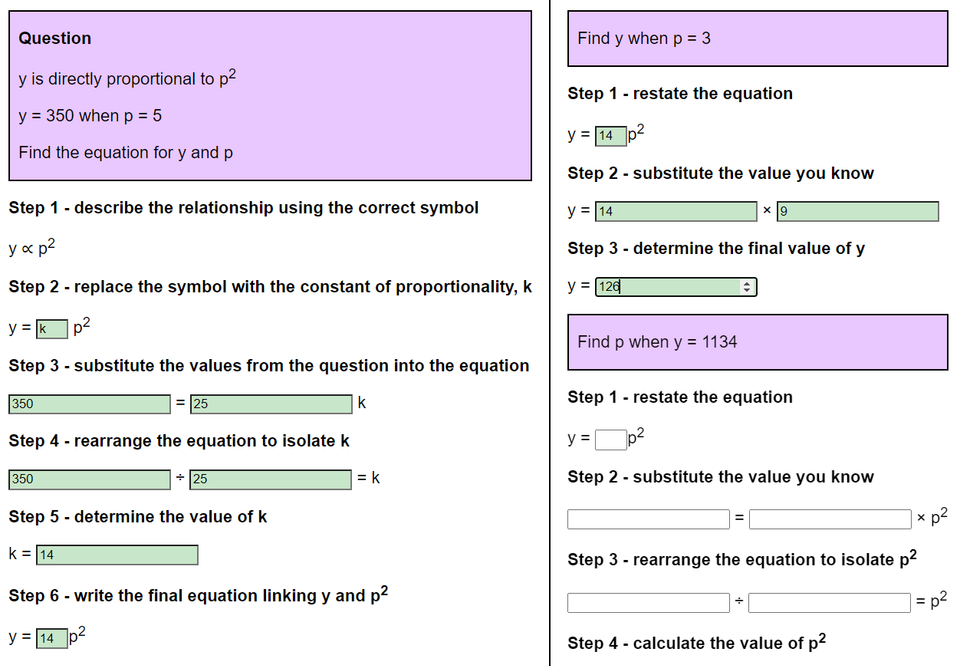
Direct proportion to the square is when one quantity increases or decreases in proportion to the square of another quantity. This relationship is common in areas like physics, where force and area are connected, or in geometry when calculating areas of shapes. Understanding this concept helps in solving problems where changes aren't linear but grow or shrink more rapidly. Jump to the questions
Practise now
Worksheet preview and key skills
Worksheet preview
Practise direct proportion to the square with this self-marking maths worksheet.
The interactive worksheet below generates questions, gives instant feedback, and lets students record their score.
What you’ll practise
- Recognising that one quantity is directly proportional to the square of another.
- Writing a relationship such as y ∝ x² or y = kx².
- Finding the constant of proportionality.
- Substituting values to find a missing quantity.
Use the interactive worksheet below, or read the Topic guide for the method and worked example.
Topic guide
What this worksheet practises
This worksheet provides practice on direct proportion to the square of a number. This means that as one variable increases, the other variable increases at an accelerating rate. For example, if a car travels twice as fast, its braking distance doesn't just double; it quadruples (2²).
Key method
To calculate missing values, you must build an algebraic equation using a constant of proportionality, 'k'.
- Write the proportionality statement: y ∝ x².
- Convert this to an equation: y = kx².
- Substitute the complete pair of given values into the equation to calculate 'k'.
- Rewrite the equation with your newly found value for 'k'.
- Substitute the final known value into this specific equation to find the missing answer.
Worked example
y is directly proportional to the square of x. When x = 4, y = 48. Find y when x = 6.
Step 1: Write the equation.
y = kx²
Step 2: Substitute the known values to find k.
48 = k × 4²
48 = k × 16
k = 48 ÷ 16 = 3.
Step 3: Write the full equation.
y = 3x²
Step 4: Answer the question by substituting x = 6.
y = 3 × 6²
y = 3 × 36 = 108.
Common mistakes to avoid
The most common mistake is confusing "y is proportional to the square of x" with "y is proportional to the square root of x". Read the wording very carefully. Another frequent error is multiplying by 'k' before squaring the 'x' value. The rules of BIDMAS dictate that indices (squares) must be calculated before multiplication.
Things to remember
When working with direct proportion to a square, scaling up is incredibly fast. If you multiply the 'x' value by 3, the 'y' value will be multiplied by 9 (which is 3²). This shortcut can often save you from doing long algebraic calculations if the numbers are simple multiples.