
Rounding - mixed questions
Rounding is a valuable skill that helps you simplify numbers for easier estimation, whether you're dealing with large figures, decimals, or measurements. It’s commonly used in everyday tasks like budgeting, measuring, or comparing values, allowing you to focus on the most relevant digits without sacrificing too much accuracy. Jump to the questions
Practise now
Worksheet preview and key skills
Worksheet preview
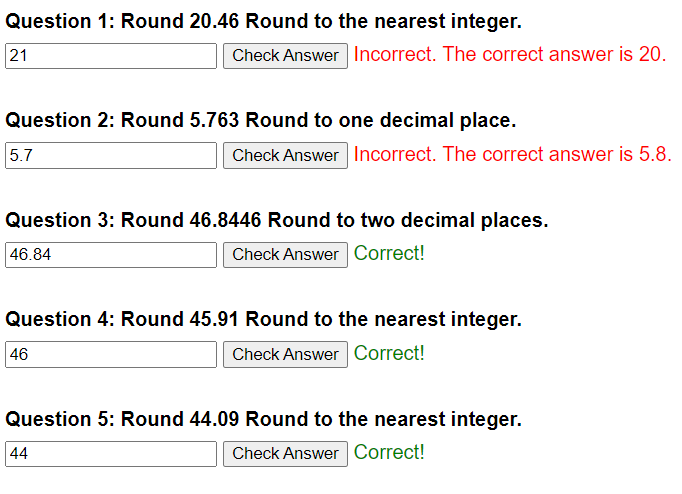
Practise rounding mixed questions with this self-marking maths worksheet.
The interactive worksheet below generates questions, gives instant feedback, and lets students record their score.
What you’ll practise
- Identifying the required rounding instruction.
- Choosing the correct place value, decimal place or significant figure.
- Using the next digit to decide whether to round up.
- Writing the rounded answer accurately.
Use the interactive worksheet below, or read the Topic guide for the method and worked example.
Topic guide
What this worksheet practises
This worksheet provides mixed practice on all types of rounding: decimal places, significant figures, and nearest 10/100/1000. The major challenge here is rapidly switching between the different rules without getting confused.
Key methods to distinguish
You must read the instructions carefully to know where to start counting.
- Decimal Places (d.p.): Start counting only after the decimal point. The size of the whole number in front of the point is completely ignored. E.g., 2 d.p. means finding the second digit after the dot.
- Significant Figures (s.f.): Start counting from the very first non-zero digit you see, reading from left to right. This applies to both massive numbers and tiny decimals. E.g., 2 s.f. for 0.00456 means the '5' is your target.
- Nearest 10, 100, etc: Identify the specific place value column (the tens column, the hundreds column) and use the digit to its right as the decider.
Worked example
Take the number 408.736 and round it to:
a) 1 decimal place
b) 2 significant figures
c) the nearest ten
a) 1 d.p: The first digit after the point is 7. The decider is 3. It stays the same.
Answer: 408.7
b) 2 s.f: The 1st s.f. is 4. The 2nd s.f. is 0. The decider is 8, so the 0 rounds up to 1. We need a placeholder for the units.
Answer: 410
c) Nearest ten: The tens column has a 0. The decider (units) is 8, so the 0 rounds up to 1. We need a placeholder for the units.
Answer: 410
Common mistakes to avoid
The most common mistake in mixed exercises is confusing 1 decimal place with 1 significant figure. For the number 14.82: 1 d.p. is 14.8. However, 1 s.f. is 10 (because the 1 is the most significant figure, and the 4 tells it to stay the same). They give entirely different answers.
Things to remember
Placeholder zeroes are required for significant figures and "nearest 10/100" to keep the number the right size. However, you should never add placeholder zeroes to the end of a decimal when rounding to decimal places, unless the question specifically forces you to (e.g., "Write 4.98 to 1 d.p." becomes 5.0, where the zero is necessary to prove the precision).