
Rounding to 2 decimal places
Rounding to two decimal places is especially important in financial calculations, like dealing with currency, interest rates, or tax. It ensures accuracy when working with money, as most currencies use two decimal places for precise values. Jump to the questions
Practise now
Worksheet preview and key skills
Worksheet preview
Practise rounding to 2 decimal places with this self-marking maths worksheet.
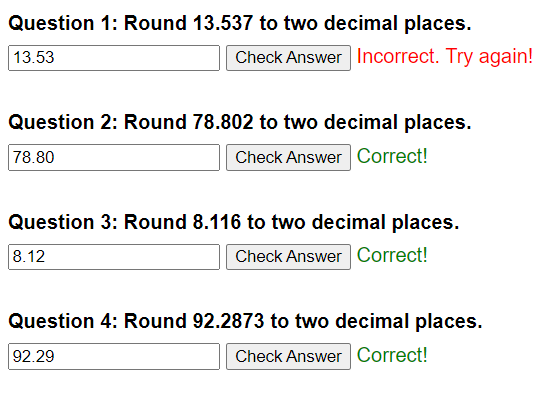
The interactive worksheet below generates questions, gives instant feedback, and lets students record their score.
What you’ll practise
- Identifying the hundredths place.
- Looking at the thousandths digit.
- Deciding whether to round up or keep the hundredths digit the same.
- Writing the answer to 2 decimal places.
Use the interactive worksheet below, or read the Topic guide for the method and worked example.
Round each of the following decimal numbers to two decimal places.
Topic guide
What this worksheet practises
This worksheet provides practice on rounding numbers to exactly two digits after the decimal point (2 d.p.). This is the absolute standard for dealing with money (e.g., £14.99), as currency generally only goes down to hundredths of a pound or dollar.
Key method
You must count two places exactly from the decimal point.
- Locate the decimal point.
- Count two digits to the right. This second digit is your target (the 2nd decimal place).
- Look at the digit immediately to the right of your target (the 3rd decimal place). This is your "decider".
- If the decider is 5 or more, round your target digit up by one.
- If the decider is 4 or less, keep your target digit the same.
- Write out the full number, stopping exactly after your target digit. Delete all numbers that follow it.
Worked example
Round 5.7281 to 2 decimal places.
Step 1: Find the 2nd decimal place. The 7 is the 1st, so the 2 is the 2nd.
Step 2: Look at the decider to its right. It is an 8.
Step 3: Because 8 is five or more, we round the 2 up to a 3.
Step 4: Write the number, stopping after the new 3. Drop the 8 and the 1.
The final answer is 5.73.
Common mistakes to avoid
The most common mistake is confusing decimal places with significant figures. If asked to round 125.728 to 2 decimal places, the answer is 125.73. If asked to round it to 2 significant figures, the answer is 130. Always read the instruction carefully: "decimal places" means you start counting from the dot.
How to check your answer
Unless the question specifically involves an annoying "carry over" (like rounding 5.998 to 6.00), your final answer should always have exactly two visible digits after the decimal point, regardless of what the whole number in front looks like.