
Direct proportion
Direct proportion is a concept where two quantities increase or decrease at the same rate. It’s useful in situations like scaling recipes, converting measurements, or calculating travel times. Understanding direct proportion helps you solve real-world problems where one quantity directly affects another. Jump to the questions
Practise now
Worksheet preview and key skills
Worksheet preview
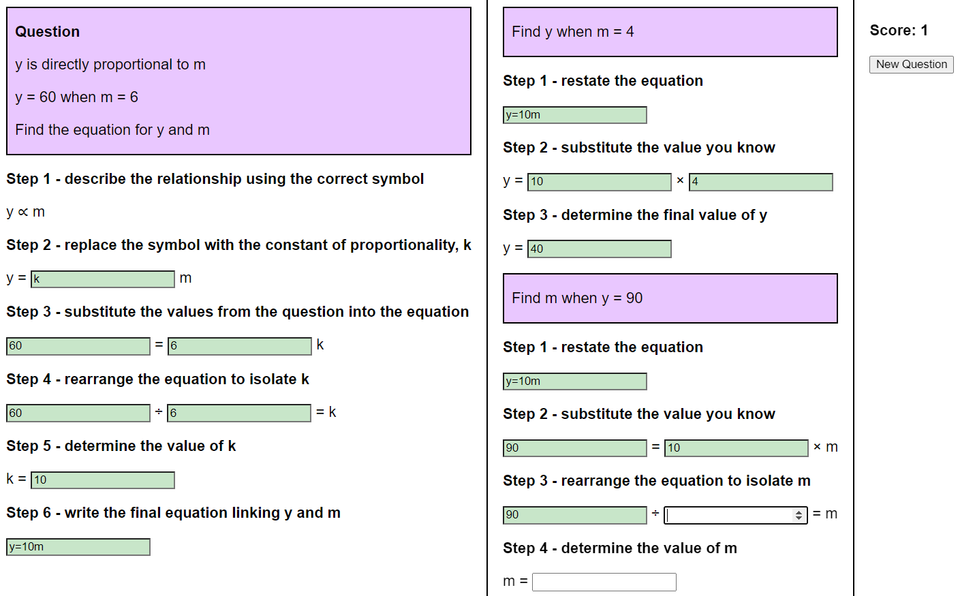
Practise direct proportion with this self-marking maths worksheet.
The interactive worksheet below generates questions, gives instant feedback, and lets students record their score.
What you’ll practise
- Recognising when two quantities increase in the same ratio.
- Finding the constant of proportionality.
- Writing or using a direct proportion relationship.
- Substituting values to find a missing quantity.
Use the interactive worksheet below, or read the Topic guide for the method and worked example.
Topic guide
What this worksheet practises
This worksheet provides practice on simple direct proportion. Direct proportion means that two quantities increase or decrease at the exact same rate. For example, if you buy twice as many apples, it will cost exactly twice as much. Their ratio remains constant.
Key method
The most reliable method for solving direct proportion problems is the "unitary method" (finding the value of a single unit).
- Identify the two quantities given in the complete pair (e.g., the cost for a certain number of items).
- Divide the total amount by the number of items to find the value of exactly one unit.
- Multiply this single unit value by the new number of items you need to find.
- Alternatively, you can use the algebraic method: write y = kx, substitute the first pair of values to find the constant 'k', and then use the equation to find the missing value.
Worked example
If 5 identical books cost £30, how much will 8 books cost?
Step 1: Find the value of a single unit (1 book).
30 ÷ 5 = 6.
One book costs £6.
Step 2: Multiply this unit value by the required amount (8 books).
6 × 8 = 48.
The answer is £48.
Common mistakes to avoid
The most common error is performing the division backwards when finding the single unit. In the example above, calculating 5 ÷ 30 instead of 30 ÷ 5. Always think about what the resulting number means: does it represent "books per pound" or "pounds per book"? You almost always want to find the cost or weight of a single object.
How to check your answer
Use simple estimation and logic to verify your answer. If 5 books cost £30, then 10 books would cost double that (£60). Since you are trying to find the cost of 8 books, the final answer must fall somewhere between £30 and £60. Our answer of £48 fits perfectly into this range.