
Inverse proportion
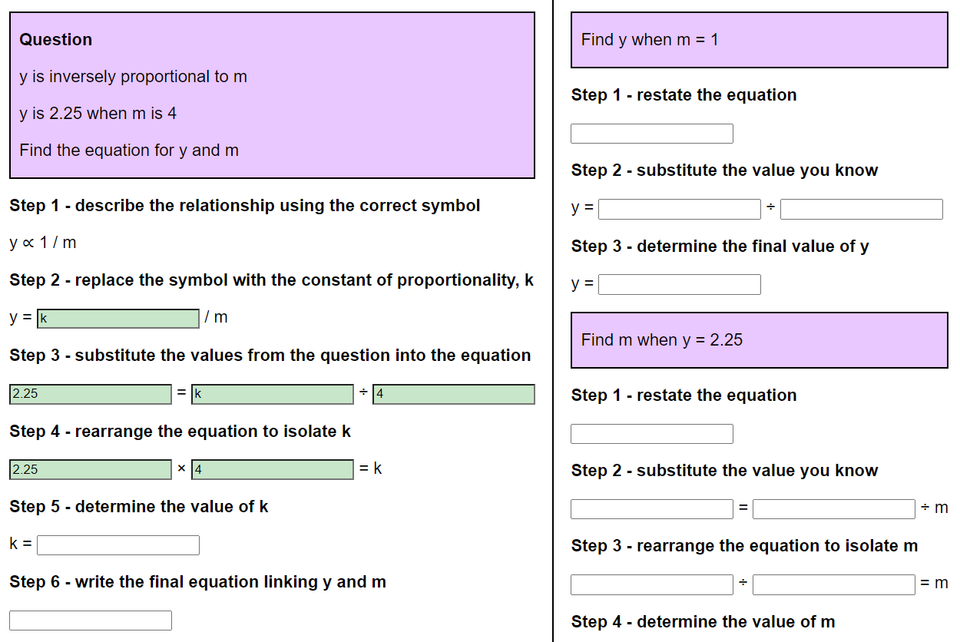
Inverse proportion is when one quantity increases as another decreases, and vice versa. This relationship is found in everyday scenarios like speed and travel time, or supply and demand. Understanding inverse proportion helps you solve problems where two quantities are inversely related, allowing you to predict how one affects the other. Jump to the questions
Practise below
Worksheet preview and key skills
Worksheet preview
Practise inverse proportion with this self-marking maths worksheet.
The interactive worksheet below generates questions, gives instant feedback, and lets students record their score.
What you’ll practise
- Recognising when one quantity increases as another decreases.
- Finding the constant of proportionality.
- Writing or using an inverse proportion relationship.
- Substituting values to find a missing quantity.
Use the interactive worksheet below, or read the Topic guide for the method and worked example.
Topic guide
What this worksheet practises
This worksheet provides practice on basic inverse proportion (often called indirect proportion). Inverse proportion happens when an increase in one quantity causes a proportional decrease in another. The classic real-world example is speed and time: the faster you drive, the less time the journey takes.
Key method
You must construct an algebraic formula containing a constant, usually called 'k'.
- Write out the relationship algebraically: y = k / x.
- Substitute the pair of known values (the 'x' and 'y' given in the question) into your equation.
- Solve the equation to find 'k'. For simple inverse proportion, this always means multiplying the two known values together (k = y × x).
- Rewrite your full formula, replacing 'k' with the number you just calculated.
- Use this completed formula to find the missing value requested in the question.
Worked example
y is inversely proportional to x. When x = 5, y = 12. Find the value of y when x = 10.
Step 1: Write the base equation.
y = k / x
Step 2: Substitute the known values to find 'k'.
12 = k / 5
k = 12 × 5 = 60.
Step 3: Write the full formula.
y = 60 / x
Step 4: Answer the question (Find y when x = 10).
y = 60 / 10
y = 6.
Common mistakes to avoid
The most common mistake is confusing inverse proportion with direct proportion. If a student uses the direct proportion formula (y = kx), they will calculate k = 12/5 = 2.4, leading to a completely wrong final answer. Always look out for the word "inversely".
How to check your answer
The defining rule of simple inverse proportion is that the two variables multiplied together must always equal the same constant number ('k'). In our example, the first pair is 5 × 12 = 60. Our second pair is 10 × 6 = 60. Because they both equal 60, the answer is verified.