
Rounding to the nearest whole number
Rounding to the nearest integer is a practical skill used in everyday situations, like estimating costs, simplifying measurements, or making quick calculations. It helps you quickly approximate values without needing exact precision, making it useful in real-world decision-making. Jump to the questions
Practise now
Worksheet preview and key skills
Worksheet preview
Practise rounding to the nearest whole number with this self-marking maths worksheet.
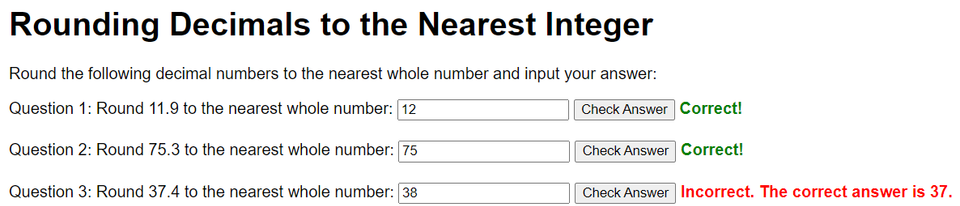
The interactive worksheet below generates questions, gives instant feedback, and lets students record their score.
What you’ll practise
- Identifying the units place.
- Looking at the tenths digit.
- Deciding whether to round up or keep the units digit the same.
- Writing the rounded whole number.
Use the interactive worksheet below, or read the Topic guide for the method and worked example.
Round the following decimal numbers to the nearest whole number and check your answer.
Topic guide
What this worksheet practises
This worksheet provides practice on rounding decimal numbers to the nearest whole number (integer). This essentially asks: "Is this decimal closer to the whole number below it, or the whole number above it?".
Key method
To round to the nearest whole number, you must look at the first digit after the decimal point.
- Identify the Units column (the single digit sitting just in front of the decimal point). This is your target digit.
- Look at the digit immediately to its right (the Tenths column, just after the point). This is your "decider".
- If the decider is 5 or more, round your Units digit up by one.
- If the decider is 4 or less, keep your Units digit the same.
- Write your new whole number and completely drop the decimal point and everything after it.
Worked example
Round 18.73 to the nearest whole number.
Step 1: Find the Units column. It is the 8.
Step 2: Look at the decider immediately after the point. It is a 7.
Step 3: Because 7 is five or more, we round the 8 up to a 9.
Step 4: The 18 becomes 19. Drop the .73 entirely.
The final answer is 19.
Common mistakes to avoid
A common error is keeping the decimal point and replacing the trailing numbers with zeroes (e.g. writing 19.00 instead of 19). While 19.00 is technically equal to 19, writing it like that implies you have rounded to two decimal places, not to a whole number. Always drop the decimal point entirely when asked for a whole number.
Things to remember
If you have to round 39.6 to the nearest whole number, the decider is 6, so the 9 rounds up to 10. The 1 carries over, making the 3 a 4. The correct answer is 40.