
Evaluating functions - easier
Evaluating functions is like using a machine: you feed in a number, and it gives you an output based on a rule. This skill is vital in real life wherever formulas are used – from calculating phone bills to predicting profits or even tracking how fast a car is going. Jump to the questions
Practise now
Worksheet preview and key skills
Worksheet preview
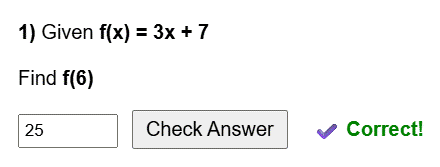
Practise evaluating functions with this self-marking maths worksheet.
The interactive worksheet below generates questions, gives instant feedback, and lets students record their score.
What you’ll practise
- Reading function notation.
- Substituting input values into a function.
- Following the operations in the correct order.
- Calculating the output value.
Use the interactive worksheet below, or read the Topic guide for the method and worked example.
Topic guide
What this worksheet practises
This worksheet provides practice on evaluating simple functions. A function is like a mathematical machine: you put a number in (the input), the machine applies a specific rule to it, and spits a number out (the output). This topic introduces formal function notation, which is heavily used in higher-level algebra.
Key method
Function notation looks like f(x). This is read as "f of x". It means "a function called 'f' that takes an input 'x'".
- Identify the given function rule (for example, f(x) = 3x + 2).
- Look at the number inside the brackets of the question. For example, if asked to find f(4), your input number is 4.
- Everywhere you see an 'x' in the rule, replace it with that input number in brackets.
- Calculate the final result using normal BIDMAS/BODMAS rules.
Worked example
Given that f(x) = 5x − 3, evaluate f(6).
Step 1: Identify the input number. The question asks for f(6), so the input is 6.
Step 2: Substitute the 6 into the function rule wherever there is an 'x'.
f(6) = 5(6) − 3.
Step 3: Perform the calculation, remembering that a number next to a bracket means multiply.
f(6) = 30 − 3.
f(6) = 27.
Common mistakes to avoid
The most common mistake is misinterpreting the notation. Many students see f(x) and think it means "f multiplied by x". The 'f' is just the name of the function, not a variable. Another common error is messing up negative inputs; always put negative input numbers inside brackets when substituting (e.g., if x is −2, write 5(−2), not 5 − 2).
Things to remember
Functions don't have to be called 'f'. You will often see g(x) or h(x). The letter at the front is just a label so you know which "machine" to put your number into if a question has more than one rule.