
Evaluating positive powers
We often come across powers (or exponents) when dealing with things that grow or shrink quickly — like population growth, viral videos, or even computer speeds. Evaluating positive powers helps us understand how repeated multiplication works, and it's a key skill for working with scientific notation, area and volume formulas, and much more. Jump to the questions
Practise now
Worksheet preview and key skills
Worksheet preview
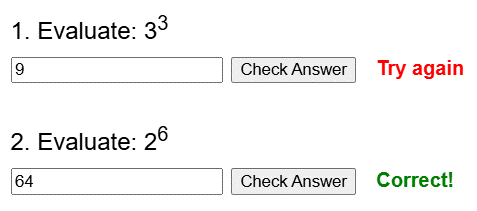
Practise evaluating positive powers with this self-marking maths worksheet.
The interactive worksheet below generates questions, gives instant feedback, and lets students record their score.
What you’ll practise
- Reading the base and exponent.
- Multiplying the base by itself the correct number of times.
- Evaluating positive integer powers.
- Calculating powers accurately.
Use the interactive worksheet below, or read the Topic guide for the method and worked example.
Evaluate the following positive powers.
Topic guide
What this worksheet practises
This worksheet provides practice on evaluating numbers raised to positive powers (indices). This is the fundamental building block for all higher-level algebra, standard form, and exponential growth topics.
Key method
A power (or index) simply tells you how many times to multiply the base number by itself.
- Identify the large base number. This is the number you will be multiplying.
- Identify the small floating number (the power or index). This tells you the total number of times the base number must appear in the multiplication sum.
- Write out the full multiplication explicitly to avoid silly errors.
- Calculate the final result step-by-step.
Worked example
Evaluate 24 and 5³.
Step 1: Evaluate 24.
The base is 2. It must appear 4 times.
Write it out: 2 × 2 × 2 × 2.
Calculate in pairs: 2 × 2 = 4. 4 × 2 = 8. 8 × 2 = 16.
So, 24 = 16.
Step 2: Evaluate 5³.
The base is 5. It must appear 3 times.
Write it out: 5 × 5 × 5.
Calculate: 5 × 5 = 25. 25 × 5 = 125.
So, 5³ = 125.
Common mistakes to avoid
The most common and frustrating mistake is multiplying the base number by the power. For example, saying that 24 = 8 (because 2 × 4 = 8). The power is an instruction of how many times to multiply the base by itself. Writing out the full sum (2 × 2 × 2 × 2) immediately prevents this mistake.
Things to remember
Anything to the power of 1 is just the number itself (e.g. 7¹ = 7). A much stranger rule is that anything to the power of 0 is exactly 1 (e.g. 7° = 1). Memorise this rule as it appears frequently in exams to trick students.