
Evaluating negative powers
We often come across negative powers in science and finance — like when dealing with very small quantities or calculating interest rates over time. Evaluating negative powers helps us understand how numbers shrink when divided repeatedly, and is key to working confidently with decimals, fractions, and exponential notation. Jump to the questions
Practise now
Worksheet preview and key skills
Worksheet preview
Practise evaluating negative powers with this self-marking maths worksheet.
The interactive worksheet below generates questions, gives instant feedback, and lets students record their score.
What you’ll practise
- Recognising that a negative power gives a reciprocal.
- Rewriting negative powers as fractions.
- Evaluating the corresponding positive power.
- Simplifying the final value.
Use the interactive worksheet below, or read the Topic guide for the method and worked example.
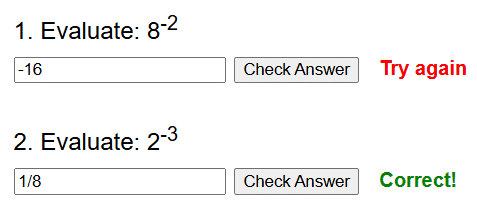
Evaluate the following negative powers. Answers can be written as fractions or decimals.
Topic guide
What this worksheet practises
This worksheet provides practice on evaluating numbers with negative powers. Negative indices are often deeply misunderstood. They do not turn the base number into a negative number; instead, they create fractions.
Key method
A negative power means you must find the reciprocal of the number.
- To deal with a negative power, immediately turn the base number into a fraction by placing a '1' over it.
- At exactly the same time, drop the minus sign from the power, making the power positive.
- Finally, calculate the normal positive power on the bottom of the fraction.
Worked example
Evaluate 5−2.
Step 1: Apply the reciprocal rule. Put a 1 over the base number.
1 / 5
Step 2: Keep the power, but make it positive. It moves to the bottom with the 5.
1 / 5²
Step 3: Evaluate the normal positive power on the bottom.
5² = 25.
The final answer is 1/25.
Common mistakes to avoid
The single most common mistake is confusing a negative power with a negative number. For example, concluding that 5−2 is −25. A negative power never makes the final answer negative (unless the starting base number was already negative). It only creates a fraction.
Things to remember
If the base number is already a fraction, the negative power simply flips the entire fraction upside down. For example, (2/3)−1 immediately becomes 3/2. The negative sign in the power has now done its job and disappears.