
Tables of values - easier
Tables of values help us see how a function works — a bit like a machine where you put numbers in and get numbers out. Just like predicting the next score in a video game or the cost of items in a shop, filling in tables of values helps us spot patterns and understand how inputs and outputs are connected. Jump to the questions
Practise now
Worksheet preview and key skills
Worksheet preview
Practise tables of values with this self-marking maths worksheet.
The interactive worksheet below generates questions, gives instant feedback, and lets students record their score.
What you’ll practise
- Substituting x-values into a formula.
- Calculating matching y-values.
- Completing a table of values.
- Preparing points for drawing a graph.
Use the interactive worksheet below, or read the Topic guide for the method and worked example.
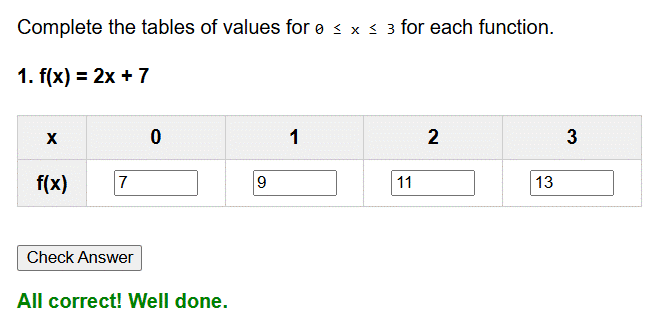
Complete the tables of values for 0 ≤ x ≤ 3 for each function.
Topic guide
What this worksheet practises
This worksheet provides practice on completing tables of values for simple linear graphs (e.g. y = 2x + 1). A table of values is just a list of coordinates that you calculate so you can draw the graph correctly.
Key method
To fill in the table, you must substitute the 'x' numbers into the equation one at a time to find their matching 'y' partners.
- Look at the equation given (e.g. y = 3x − 2).
- Take the first 'x' value from the top row of your table.
- Substitute that number in place of the 'x' in the equation. Remember that a number next to a letter means multiply (3x means 3 times x).
- Calculate the answer. This is your 'y' value. Write it in the empty box underneath.
- Repeat this for every 'x' number in the table.
Worked example
Complete the table of values for y = 2x + 4.
x values: 0, 1, 2
Step 1: Calculate the y value when x = 0.
y = 2(0) + 4
y = 0 + 4 = 4.
(Write 4 under the 0).
Step 2: Calculate the y value when x = 1.
y = 2(1) + 4
y = 2 + 4 = 6.
(Write 6 under the 1).
Step 3: Calculate the y value when x = 2.
y = 2(2) + 4
y = 4 + 4 = 8.
(Write 8 under the 2).
The completed y-row is: 4, 6, 8.
Common mistakes to avoid
The most common mistake happens when dealing with negative 'x' numbers. If the equation is y = 3x + 2, and x is −1, students sometimes calculate 3 × 1 = 3, and then add 2 to get 5. This ignores the negative sign entirely. You must calculate 3 × (−1) = −3, and then add 2 to get −1.
How to check your answer
For a straight line graph (a linear equation with no x²), the numbers in the 'y' row will always form a perfect sequence with a constant gap. In our example, the sequence was 4, 6, 8 (going up by 2 every time). This matches the "2" in front of the x in y = 2x + 4. If your numbers do not form a regular pattern, you have made a calculation error.