
Fibonacci sequences
Fibonacci sequences pop up in nature more than you might expect — from the spiral of sunflower seeds to the shape of pinecones and seashells. This fascinating sequence starts simply, but grows rapidly, showing how patterns can emerge from the simplest of rules. Jump to the questions
Practise now
Worksheet preview and key skills
Worksheet preview
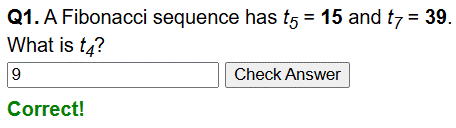
Practise Fibonacci sequences with this self-marking maths worksheet.
The interactive worksheet below generates questions, gives instant feedback, and lets students record their score.
What you’ll practise
- Recognising that each term is made from earlier terms.
- Adding the previous two terms to generate the next term.
- Continuing the sequence accurately.
- Identifying missing terms where needed.
Use the interactive worksheet below, or read the Topic guide for the method and worked example.
Topic guide
What this worksheet practises
This worksheet provides practice on Fibonacci sequences. Unlike arithmetic sequences (which go up by a fixed amount) or geometric sequences (which multiply by a fixed amount), a Fibonacci-style sequence creates its next term by adding previous terms together.
Key method
The defining rule of any Fibonacci sequence is very simple: to find the next number, you add the two previous numbers together.
- Identify the last two numbers you have in the sequence.
- Add them together.
- Write this result down as the next term.
- To find the term after that, shift your focus one step to the right, and add the two newest numbers together.
- If you need to work backwards, subtract the smaller number from the larger number to find the missing previous term.
Worked example
A sequence follows a Fibonacci rule. The first terms are: 2, 5, 7, 12... Find the next three terms.
Step 1: Verify the rule. 2 + 5 = 7. 5 + 7 = 12. The rule works.
Step 2: Find the 5th term by adding the 3rd and 4th terms.
7 + 12 = 19.
Step 3: Find the 6th term by adding the 4th and 5th terms.
12 + 19 = 31.
Step 4: Find the 7th term by adding the 5th and 6th terms.
19 + 31 = 50.
The next three terms are 19, 31, and 50.
Common mistakes to avoid
A common error is adding the first term to the last term, or trying to find a constant common difference (like an arithmetic sequence). If a question explicitly mentions "Fibonacci", stop looking for a steady gap and immediately start adding adjacent terms together.
Things to remember
The famous "original" Fibonacci sequence starts with 1, 1... which creates the pattern 1, 1, 2, 3, 5, 8, 13, 21. However, a "Fibonacci-style" sequence can start with any two random numbers, including algebra. For example, starting with 'a' and 'b' creates the sequence: a, b, a+b, a+2b, 2a+3b.