
Place value - integers and decimals
Every number you see is made up of digits, and where each digit sits gives it its true value — that’s place value. It’s why the “5” in 50 means fifty, while the “5” in 0.5 means half — same digit, totally different worth! Jump to the questions
Looking for place value for integers only?
Practise now
Worksheet preview and key skills
Worksheet preview
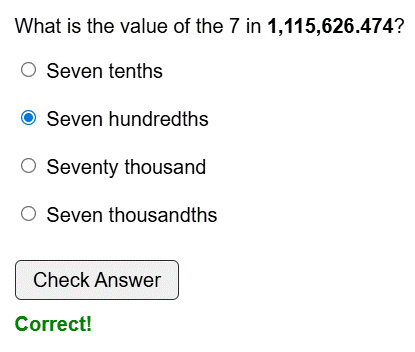
Practise place value with integers and decimals with this self-marking maths worksheet.
The interactive worksheet below generates questions, gives instant feedback, and lets students record their score.
What you’ll practise
- Identifying digit values in whole numbers and decimals.
- Using tenths, hundredths and thousandths where relevant.
- Comparing digits by place value.
- Reading decimal numbers accurately.
Use the interactive worksheet below, or read the Topic guide for the method and worked example.
Topic guide
What this worksheet practises
This worksheet provides practice on identifying the place value of digits in numbers that contain a decimal point. Understanding the columns to the right of the decimal point is crucial for ordering decimals and converting between fractions and decimals.
Key method
The decimal point acts as a mirror, but the names on the right-hand side all end in "ths", indicating they are fractions of a whole.
- The first column after the point is the Tenths (1/10 or 0.1).
- The second column is the Hundredths (1/100 or 0.01).
- The third column is the Thousandths (1/1000 or 0.001).
- To find the true value of a decimal digit, write a zero, the decimal point, and then replace any other numbers in front of it with zeroes.
Worked example
What is the true value of the 8 in the number 24.385? Give your answer as a decimal and as a fraction.
Step 1: Identify the column. The 3 is in the tenths, so the 8 is in the hundredths column.
Step 2: Write it as a decimal. Put a zero in the units, keep the point, put a zero where the 3 is, and write the 8.
Decimal value: 0.08.
Step 3: Write it as a fraction. Because it is in the "hundredths" column, the denominator is 100.
Fraction value: 8/100.
Common mistakes to avoid
A frequent mistake is thinking the first column after the decimal point is the "oneths" or "units" column (matching the symmetry of the whole numbers perfectly). There is no "oneths" column. The columns start immediately at tenths.
Things to remember
The further to the right a digit goes past the decimal point, the smaller its value becomes. 0.009 might look like a big number because of the 9, but it is actually much smaller than 0.1.