
Expanding single brackets - easier problems
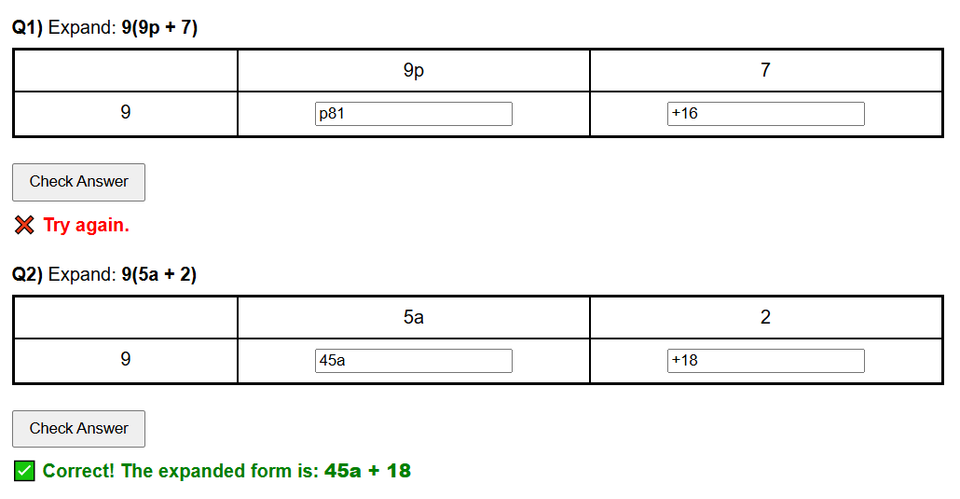
You’ll often come across expressions like 3(x + 4) in algebra – and learning to expand single brackets helps you simplify these expressions. This skill pops up all over the place, from working out costs in real-life problems to solving equations in science and engineering. Jump to the questions
Practise now
Worksheet preview and key skills
Worksheet preview
Practise expanding single brackets with this self-marking maths worksheet.
The interactive worksheet below generates questions, gives instant feedback, and lets students record their score.
What you’ll practise
- Multiplying each term inside the bracket.
- Applying the multiplier to every term.
- Handling positive and negative terms carefully.
- Writing the expanded expression.
Use the interactive worksheet below, or read the Topic guide for the method and worked example.
Expand the following expressions using the grid method.
Topic guide
What this worksheet practises
This worksheet provides practice on the fundamental skill of expanding single brackets. In algebra, a number or letter sitting directly outside a bracket means "multiply everything inside".
Key method
To expand the bracket, you must distribute the outside term across every term inside.
- Identify the term immediately outside the bracket.
- Draw a small arrow pointing from the outside term to the first term inside. Multiply them together and write the result down.
- Draw a second arrow from the outside term to the second term inside. Multiply them together. Be careful with any negative signs.
- Combine these two results into a single algebraic expression.
Worked example
Expand 4(3x − 5).
Step 1: Multiply the outside number (4) by the first term inside (3x).
4 × 3x = 12x.
Step 2: Multiply the outside number (4) by the second term inside (−5).
4 × −5 = −20.
Step 3: Write out the complete expression.
12x − 20.
Common mistakes to avoid
The most common and frustrating mistake for examiners to see is a student multiplying the first term correctly but completely forgetting to multiply the second term. For example, expanding 4(3x − 5) to become 12x − 5. You must multiply every single item inside the bracket by the number outside.
How to check your answer
Pick a simple number, like x = 2. Substitute it into the original question: 4 × (3(2) − 5) = 4 × (6 − 5) = 4 × 1 = 4. Now substitute it into your answer: 12(2) − 20 = 24 − 20 = 4. Because both calculations give the same result, your algebra is correct.