
Expanding single brackets with surds
Expanding brackets with surds is an important algebra skill because surds often appear in exact answers, especially in topics like Pythagoras’ theorem, trigonometry, area, and algebraic proof.
Instead of rounding awkward square roots to decimals, surds let us keep answers exact. This means we can work with values like √2, √5, or 3√7 accurately.
The method is just like normal expanding brackets: multiply the term outside the bracket by each term inside the bracket. The extra step is simplifying the surds afterwards. For example, √2 × √8 = √16 = 4, and 3√5 × 2√7 = 6√35.
Practise now
Worksheet preview and key skills
Worksheet preview
Practise expanding single brackets with surds with this self-marking maths worksheet.
The interactive worksheet below generates questions, gives instant feedback, and lets students record their score.
What you’ll practise
- Multiplying each term inside the bracket.
- Applying surd multiplication rules.
- Simplifying surds where possible.
- Collecting like surd terms if needed.
Use the interactive worksheet below, or read the Topic guide for the method and worked example.
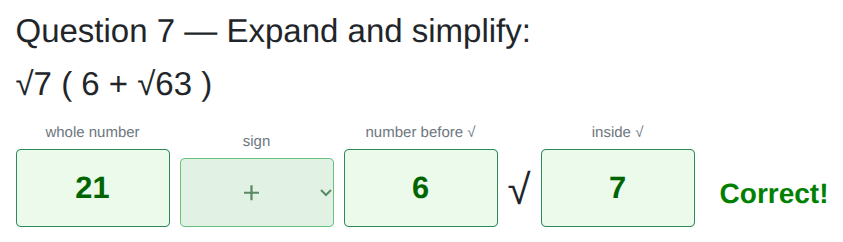
Expand the bracket and simplify your answer. Use the answer boxes provided. You do not need to type the square root symbol — enter the coefficient and the number inside the square root in the boxes.
Topic guide
What this worksheet practises
This worksheet gives you practice in expanding single brackets where the terms inside or outside the bracket include surds. This process is very similar to expanding normal algebraic brackets, but requires an extra step to simplify the resulting surds.
Why this is useful
Surds are used to keep mathematical answers exact. Being able to expand and simplify expressions with surds is useful when working with Pythagoras' theorem, trigonometry, calculating exact lengths and areas, or performing more advanced algebraic manipulation.
Key method
To expand a bracket involving surds, follow these steps:
- Multiply the term outside the bracket by each term inside the bracket separately.
- Multiply the ordinary numbers (coefficients) together normally.
- Multiply the numbers inside the square roots together, using the rule √a × √b = √(ab).
- Simplify any resulting surds where possible (for example, by looking for square number factors).
- Write your final answer in its simplest form.
Worked example
Consider the expression:
3√2(4√2 + 5√3)
First, multiply the outside term by the first term inside the bracket:
- 3√2 × 4√2 = 12√4 = 12 × 2 = 24
Next, multiply the outside term by the second term inside the bracket:
- 3√2 × 5√3 = 15√6
Finally, combine these parts to write the full expanded expression:
3√2(4√2 + 5√3) = 24 + 15√6
Common mistakes to avoid
- Only multiplying the first term inside the bracket and forgetting the second.
- Forgetting to multiply the coefficients (the numbers in front of the surds).
- Forgetting that multiplying a surd by itself produces an integer (e.g., √2 × √2 = 2), and leaving it unsimplified as √4.
- Leaving parts of the final answer unsimplified, such as writing √18 instead of fully simplifying it to 3√2.
- Entering the radicand (the number inside the root) and the coefficient (the number outside) the wrong way round in the answer boxes.
How to use the answer boxes
You do not need to type the square root symbol when entering your answers. The boxes will guide you on what to input.
For an answer like 24 + 15√6:
- Enter 24 into the 'whole number' box.
- Choose the + sign from the dropdown.
- Enter 15 into the 'number before √' box.
- Enter 6 into the 'inside √' box.
If your final answer is just a single surd term, you will only see boxes for the coefficient and the number inside the square root. If the answer simplifies entirely to an integer, you will only see a box for the whole number.
Things to remember
- Expand every term in the bracket carefully.
- Multiply the coefficients and the surds separately.
- Always check if the surd part of your answer can be simplified further.
- Double-check that your final answer components match the specific boxes provided.