
Finding turning points by completing the square
Turning points are where a curve changes direction — like the peak of a hill or the bottom of a valley. They're used in everything from designing rollercoasters to predicting profits in business, making them a key part of understanding how things rise and fall in the real world. Jump to the questions
Practise now
Worksheet preview and key skills
Worksheet preview
Practise finding turning points by completing the square with this self-marking maths worksheet.
The interactive worksheet below generates questions, gives instant feedback, and lets students record their score.
What you’ll practise
- Writing the quadratic in completed-square form.
- Identifying the turning point from the completed-square form.
- Recognising the minimum or maximum point where relevant.
Use the interactive worksheet below, or read the Topic guide for the method and worked example.
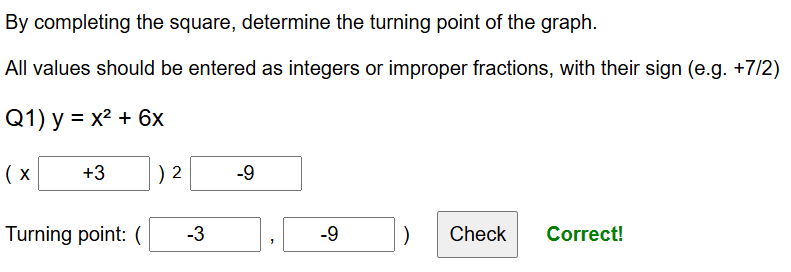
By completing the square, determine the turning point of the graph. All values should be entered as integers or improper fractions, with their sign (e.g. +7/2)
Topic guide
What this worksheet practises
This worksheet provides practice on finding the exact coordinates of the turning point (the minimum or maximum tip) of a quadratic curve. While you can find this by drawing a graph, "completing the square" allows you to find the exact coordinates purely algebraically.
Key method
First, write the quadratic expression x² + bx + c in the completed square format: (x + p)² + q.
- Halve the 'b' value (the number in front of the x) to find 'p'. This goes inside the bracket: (x + p)².
- Square that new 'p' value, and immediately subtract it outside the bracket.
- Bring down the original '+ c' to the end.
- Simplify the numbers outside the bracket to find 'q'.
- The Turning Point Coordinates: Look at your final equation (x + p)² + q. The x-coordinate is the number inside the bracket with its sign flipped (−p). The y-coordinate is the number outside the bracket exactly as it is (q).
Worked example
Find the turning point of the curve y = x² + 6x + 10.
Step 1: Halve the x-coefficient (6 ÷ 2 = 3). Write the initial bracket.
(x + 3)²
Step 2: Square the 3 (3² = 9) and subtract it outside. Bring down the + 10.
(x + 3)² − 9 + 10
Step 3: Simplify the numbers outside.
(x + 3)² + 1
Step 4: Extract the coordinates. Flip the sign inside, keep the sign outside.
The turning point is (−3, 1).
Common mistakes to avoid
The two biggest pitfalls are both sign errors. First, students often add the squared number outside the bracket instead of always subtracting it. Second, when stating the final coordinates, they forget to flip the sign of the x-coordinate inside the bracket.
How to check your answer
You can quickly check your turning point's x-coordinate using the mini-formula: x = −b / 2a. For our equation y = x² + 6x + 10, 'b' is 6 and 'a' is 1. Therefore, x = −6 / 2 = −3. This matches our completed square method perfectly.