
Completing the square
Completing the square is a method used to solve quadratic equations, and it's especially useful when formulas don't quite cut it. It's also how we derive the quadratic formula itself! You'll often see it pop up in physics when working with projectile motion or optimizing areas and distances. Jump to the questions
Practise now
Worksheet preview and key skills
Worksheet preview
Practise completing the square with this self-marking maths worksheet.
The interactive worksheet below generates questions, gives instant feedback, and lets students record their score.
What you’ll practise
- Rewriting a quadratic in completed-square form.
- Halving the coefficient of x.
- Adjusting the constant term.
- Using the completed form to interpret or solve.
Use the interactive worksheet below, or read the Topic guide for the method and worked example.
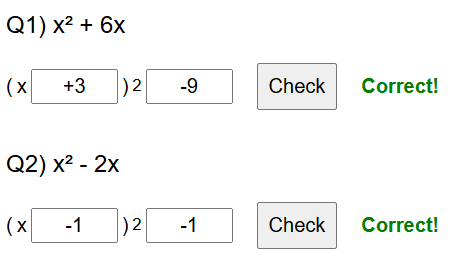
Complete the square for each quadratic expression.
Note: All values should be entered as integers or improper fractions, with their sign (e.g. +7/2, -3).
Topic guide
What this worksheet practises
This worksheet provides practice on completing the square for quadratic expressions. This is a higher-level algebra skill used to solve complex quadratic equations and to find the turning point (vertex) of a quadratic graph.
Key method
To convert a standard quadratic expression x² + bx + c into the completed square format (x + p)² + q:
- Write down a set of brackets containing 'x' and half of the 'b' coefficient. Square the entire bracket.
- Calculate the square of that halved number, and subtract it immediately outside the bracket.
- Bring down the original '+ c' constant from the end of the expression.
- Simplify the numbers outside the bracket.
Worked example
Complete the square for x² + 6x + 10
Step 1: Halve the coefficient of x (which is 6). Half of 6 is 3. Write the squared bracket.
(x + 3)²
Step 2: Subtract the square of this number (3² = 9) outside the bracket.
(x + 3)² − 9
Step 3: Bring down the original constant (+ 10) and simplify.
(x + 3)² − 9 + 10
(x + 3)² + 1
Common mistakes to avoid
A very frequent error occurs when subtracting the squared number outside the bracket. Remember that you must always subtract it, even if the number inside the bracket is negative. For instance, if the bracket is (x − 4)², the square of −4 is 16, so you must still write − 16 outside the bracket.
How to check your answer
Expand your completed square backwards to see if you return to the original expression. Expanding (x + 3)² gives x² + 6x + 9. Adding the + 1 on the end brings it back perfectly to x² + 6x + 10.