
Generating quadratic sequences
Quadratic sequences often appear in real-world situations involving curved paths or accelerating motion — like the height of a ball thrown into the air or the pattern of seats in a theatre. Learning to generate them helps us understand how things change in a non-linear way. Jump to the questions
Looking for questions on finding the nth term of a quadratic sequence?
Practise now
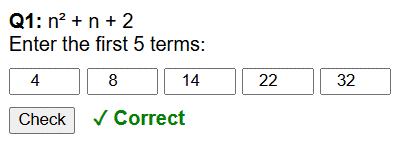
Calculate the first 5 terms for each expression.
Worksheet preview and key skills
Worksheet preview
Practise generating quadratic sequences with this self-marking maths worksheet.
The interactive worksheet below generates questions, gives instant feedback, and lets students record their score.
What you’ll practise
- Recognising that first differences are not constant.
- Using second differences where relevant.
- Generating further terms from the sequence pattern.
- Recognising a quadratic sequence.
Use the interactive worksheet below, or read the Topic guide for the method and worked example.
Topic guide
What this worksheet practises
This worksheet provides practice on generating the terms of a quadratic sequence when given its "nth term" formula. Unlike linear sequences which increase by a fixed amount, quadratic sequences accelerate, going up (or down) by different amounts each time.
Key method
The formula for a quadratic sequence always contains an n² term (e.g. 2n² + 5). You generate terms by substituting the position number for 'n'.
- To find the 1st term, substitute n = 1.
- To find the 2nd term, substitute n = 2.
- Crucial: Follow the order of operations (BIDMAS). You must square the 'n' value before multiplying it by any number in front.
- For example, if the formula is 3n², and n = 4, you calculate 4² = 16 first, and then multiply by 3 to get 48. (Doing 3 × 4 = 12, then squaring to get 144 is completely wrong).
Worked example
The nth term of a sequence is n² + 2n. Find the first three terms.
Step 1: Find the 1st term (n = 1).
1² + 2(1) = 1 + 2 = 3.
Step 2: Find the 2nd term (n = 2).
2² + 2(2) = 4 + 4 = 8.
Step 3: Find the 3rd term (n = 3).
3² + 2(3) = 9 + 6 = 15.
The first three terms are 3, 8, 15.
Common mistakes to avoid
The most catastrophic error is failing to apply BIDMAS correctly to negative numbers if your 'n' is negative (though sequence positions are usually positive) or when subtracting. For example, if the rule is 5n − n² and n = 3, it evaluates as 15 − 9 = 6. Many students accidentally square the negative sign.
How to check your answer
Unlike linear sequences, the first differences between terms will change. However, if you find the second differences (the gap between the gaps), it will always be a constant fixed number. For our sequence (3, 8, 15), the first gaps are 5 and 7. The gap between 5 and 7 is 2. This proves it is a valid quadratic sequence.