
nth term of an arithmetic (linear) sequence
When you notice a pattern in numbers, like 3, 7, 11, 15…, you’re looking at an arithmetic sequence. The nth term is a clever formula that lets you jump straight to any number in the sequence without having to write them all out. Jump to the questions
Looking to generate arithmetic or linear sequences?
Practise now
Worksheet preview and key skills
Worksheet preview
Practise the nth term of an arithmetic sequence with this self-marking maths worksheet.
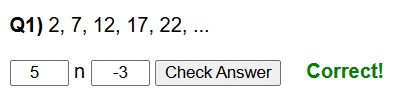
The interactive worksheet below generates questions, gives instant feedback, and lets students record their score.
What you’ll practise
- Finding the common difference.
- Using the difference as the coefficient of n.
- Adjusting to match the sequence.
- Writing the nth term rule.
Use the interactive worksheet below, or read the Topic guide for the method and worked example.
Enter the nth term rule for each sequence. Use correct signs in your constant (e.g. +2, -3).
Topic guide
What this worksheet practises
This worksheet focuses on finding the "nth term" rule for arithmetic (linear) sequences. This formula allows you to calculate what number will appear at any specific position (like the 100th term) without having to write out the entire list.
Key method
The "DINO" method (Difference, Index, Number before, zerOth term) is the most reliable way to build the formula.
- Find the Difference: Look at the sequence and calculate exactly how much it goes up (or down) by each time. Write this number down followed immediately by the letter 'n' (e.g. if it goes up by 4, write 4n).
- Find the "Zeroth" Term: Look at the very first number in the sequence. Work backwards by one single step (doing the opposite of your difference) to find the imaginary number that would sit directly in front of the sequence.
- Combine: Add or subtract your zeroth term onto the end of your 'n' term to complete the formula.
Worked example
Find the nth term formula for the sequence: 5, 8, 11, 14, 17...
Step 1: Find the common difference.
The sequence goes up by exactly 3 each time (+3).
The first part of our formula is therefore 3n.
Step 2: Find the "zeroth" term by working backwards.
The first number is 5. Since the sequence goes up by 3, working backwards means we must subtract 3.
5 − 3 = 2. This is a positive 2.
Step 3: Combine the two parts.
The final nth term formula is 3n + 2.
Common mistakes to avoid
A very common mistake occurs when the sequence is going down (decreasing). If a sequence goes 10, 8, 6, 4..., the difference is negative 2. Therefore the first part of the formula must be −2n. Students often just write 2n. Furthermore, when working backwards to find the zeroth term for a decreasing sequence, you must add the difference (10 + 2 = 12), not subtract it.
How to check your answer
To verify your formula, substitute n=1 into it. (3 × 1) + 2 = 5. This gives you the first number in the sequence. Then substitute n=2. (3 × 2) + 2 = 8. This gives the second number. If it generates the correct sequence, your formula is flawless.