
Multiplication using the grid method
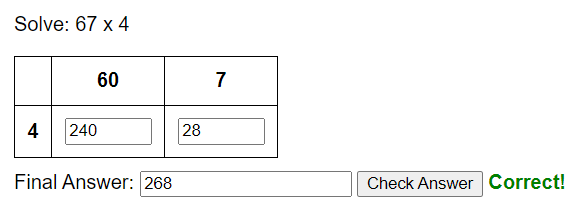
Many believe that the grid method may be the best method to learn. There aren't too many steps to remember and it lends itself well to algebraic multiplications.
Students will need to be familiar with these skills first:
Practise now
Worksheet preview and key skills
Worksheet preview
Practise multiplication using the grid method with this self-marking maths worksheet.
The interactive worksheet below generates questions, gives instant feedback, and lets students record their score.
What you’ll practise
- Partitioning numbers into place-value parts.
- Using the grid method to organise multiplication.
- Calculating partial products.
- Adding partial products to get the final answer.
Use the interactive worksheet below, or read the Topic guide for the method and worked example.
Topic guide
What this worksheet practises
This worksheet provides practice on multiplying large numbers using the grid method (sometimes called the box method). This method breaks difficult multiplications into smaller, manageable chunks, significantly reducing the chance of calculation errors.
Key method
The grid method relies on "partitioning" numbers into their hundreds, tens, and units.
- Draw a grid. The number of rows and columns depends on the size of the numbers you are multiplying.
- Partition the first number along the top of the grid. For example, 345 becomes 300, 40, and 5.
- Partition the second number down the side of the grid. For example, 27 becomes 20 and 7.
- Multiply the numbers to fill in each inner box of the grid. (Use the trick: multiply the non-zero digits, then attach all the zeroes).
- Add up all the numbers inside the grid to find your final answer. Using column addition is highly recommended for this final step.
Worked example
Calculate 43 × 26 using the grid method.
Step 1: Set up the grid. Partition 43 into 40 and 3. Partition 26 into 20 and 6.
Step 2: Fill the boxes.
Top left box (40 × 20): 4 × 2 = 8, add two zeroes = 800.
Top right box (3 × 20): 3 × 2 = 6, add one zero = 60.
Bottom left box (40 × 6): 4 × 6 = 24, add one zero = 240.
Bottom right box (3 × 6): 3 × 6 = 18.
Step 3: Add the four answers together.
800 + 240 + 60 + 18 = 1118.
Common mistakes to avoid
The most frequent error is miscounting the zeroes when multiplying the partitioned parts. For instance, calculating 300 × 40 and writing 1200 instead of 12000. Always count the total number of zeroes in the question (300 has two, 40 has one, so the answer must have three zeroes after the 12).
How to check your answer
Use estimation to check your final magnitude. 43 is roughly 40. 26 is roughly 30. 40 × 30 = 1200. Our calculated answer of 1118 is very close to 1200, confirming we haven't made a massive "zero error" during the grid calculation.