
Place value breakdown
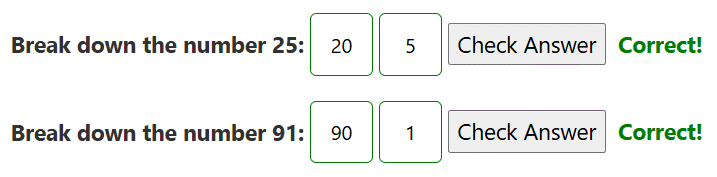
Also known as "partitioning", breaking numbers apart by place value is an important skill if you want to master multiplication using the grid method.
Practise below
Worksheet preview and key skills
Worksheet preview
Practise place value breakdown with this self-marking maths worksheet.
The interactive worksheet below generates questions, gives instant feedback, and lets students record their score.
What you’ll practise
- Breaking a number into the value of each digit.
- Using place-value columns.
- Writing numbers as sums of parts.
- Rebuilding the original number from its place-value parts.
Use the interactive worksheet below, or read the Topic guide for the method and worked example.
Break down the following numbers by place value e.g. 37 is the same as 30 and 7.
Topic guide
What this worksheet practises
This worksheet provides practice on breaking down large numbers into their constituent parts using place value. This is called "partitioning". Understanding how a number is built is the foundation for all column addition, subtraction, and multiplication.
Key method
A number's value depends entirely on which column it sits in.
- Identify the columns from right to left: Units (Ones), Tens, Hundreds, Thousands, Ten Thousands, etc.
- Take each digit individually and write down its true value by adding the correct number of zeroes behind it.
- You can write the full breakdown as an addition sum. For example, 452 is 400 + 50 + 2.
Worked example
1) What is the true value of the 7 in the number 47,382?
2) Partition the number 5,094.
Example 1:
Step 1: Look at the 7. It is in the "thousands" column.
Step 2: Write the 7, and replace all the numbers after it with zeroes (there are three numbers after it: 3, 8, 2).
The true value of the 7 is 7,000.
Example 2:
Step 1: Look at the 5 (Thousands column). It is worth 5,000.
Step 2: Look at the 0 (Hundreds column). It is worth 0, so we skip it.
Step 3: Look at the 9 (Tens column). It is worth 90.
Step 4: Look at the 4 (Units column). It is worth 4.
The partitioned number is 5,000 + 90 + 4.
Common mistakes to avoid
A common mistake when answering "What is the value of the digit..." is just writing the column name (e.g., writing "Thousands" instead of "7,000"). While you need to know the column name, the question is asking for the numerical value of that specific digit.
Things to remember
Zeroes are incredibly important as placeholders. If a number is partitioned as 6,000 + 20 + 3, you cannot just push the non-zero numbers together to make 623. Because there are no hundreds, you must put a zero in the hundreds column to keep the 6 in the thousands place: 6,023.