
Negative reciprocals
Negative reciprocals are numbers that, when multiplied together, equal -1. They often appear in geometry when dealing with perpendicular lines, as the slopes of two perpendicular lines are always negative reciprocals of each other. Understanding negative reciprocals helps in solving problems involving angles, slopes, and intersections in both math and real-world applications like construction and design. Jump to the questions
Practise now
Worksheet preview and key skills
Worksheet preview
Practise negative reciprocals with this self-marking maths worksheet.
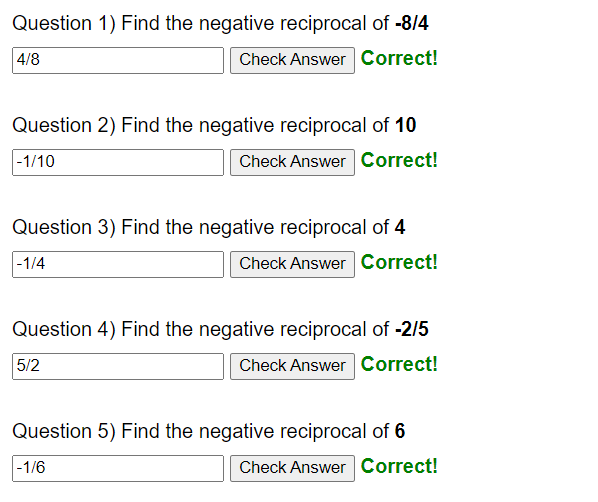
The interactive worksheet below generates questions, gives instant feedback, and lets students record their score.
What you’ll practise
- Finding the reciprocal of a number or fraction.
- Changing the sign to make the negative reciprocal.
- Using negative reciprocals for perpendicular gradients.
- Checking that the gradients multiply to -1 where relevant.
Use the interactive worksheet below, or read the Topic guide for the method and worked example.
Solve the following questions by entering the negative reciprocal of the given number as a proper or improper fraction. Decimal answers will not be accepted.
Topic guide
What this worksheet practises
This worksheet focuses on finding the negative reciprocal of a number or fraction. In coordinate geometry, if you know the gradient of a straight line, its negative reciprocal gives you the exact gradient of any line that is perpendicular to it (meeting it at a perfect 90-degree right angle).
Key method
Finding a negative reciprocal is a two-step process: flip it and switch it.
- Step 1 (The Reciprocal): If the number is a fraction, flip it upside down (e.g., 2/3 becomes 3/2). If the number is a whole integer, turn it into a fraction by putting it over 1 first, and then flip it (e.g., 5 becomes 5/1, which flips to 1/5).
- Step 2 (The Negative): Switch the sign of the flipped number. If it is positive, make it negative. If it is negative, make it positive.
Worked example
1) Find the negative reciprocal of 3/4.
2) Find the negative reciprocal of −7.
Example 1: (3/4)
Step 1: Flip it upside down to find the reciprocal. 3/4 becomes 4/3.
Step 2: Change the sign. It was positive, so make it negative.
Final Answer: −4/3.
Example 2: (−7)
Step 1: Treat −7 as −7/1. Flip it upside down to get −1/7.
Step 2: Change the sign. It was negative, so make it positive.
Final Answer: 1/7.
Common mistakes to avoid
The most common mistake is only completing one of the two steps. A student might flip a fraction but forget to change its sign (giving just the reciprocal). Or, they might change the sign but forget to flip the fraction. Remember, perpendicular lines must have opposite signs (one goes uphill, the other goes downhill).
How to check your answer
A mathematical rule states that when you multiply a number by its negative reciprocal, the answer must always be exactly −1. In our first example, (3/4) × (−4/3) = −12/12 = −1. The answer is proven correct.