
Dividing by powers of 10
Dividing by powers of 10 is a quick way to make large numbers smaller. You often see this in real life when dealing with money, measurements, or even scientific data. For example, when converting between units like meters to kilometers or dollars to cents, dividing by powers of 10 helps keep things simple and organized. Understanding this concept makes it easier to handle large or small numbers in everyday life! Jump to the questions
Practise now
Worksheet preview and key skills
Worksheet preview
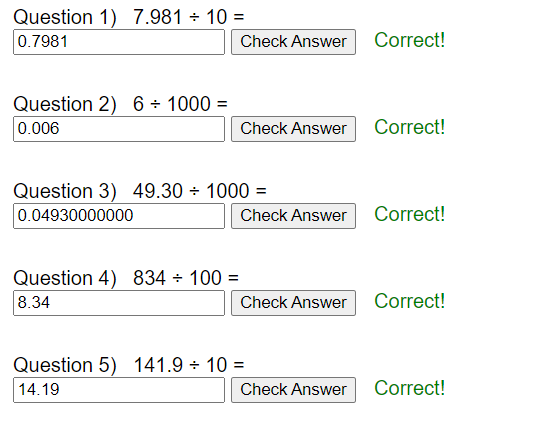
Practise dividing by powers of 10 with this self-marking maths worksheet.
The interactive worksheet below generates questions, gives instant feedback, and lets students record their score.
What you’ll practise
- Dividing by 10, 100 and 1000.
- Understanding how digits change place value.
- Working with whole numbers and decimals.
- Avoiding place-value mistakes with zeros and decimals.
Use the interactive worksheet below, or read the Topic guide for the method and worked example.
Divide the following numbers by 10, 100, or 1000.
Topic guide
What this worksheet practises
This worksheet provides practice on dividing numbers by powers of 10, such as 10, 100, and 1000. This is a fundamental mental arithmetic skill. It is crucial for unit conversions (like millimetres to centimetres) and forms the basis of calculating basic percentages.
Key method
When you divide by a power of 10, the digits of the number slide to the right across the place value columns.
- Count the number of zeroes in the power of 10 you are dividing by.
- Move the decimal point that many places to the left. (If the number is a whole number, imagine the decimal point is hiding at the very end).
- If you run out of digits, fill any empty spaces with zeroes.
Worked example
Calculate 4.2 ÷ 100.
Step 1: Count the zeroes. We are dividing by 100, which has two zeroes.
Step 2: Move the decimal point two places to the left.
The first jump moves the point past the 4, making it .42
The second jump requires another space, so we add a zero, making it .042
Step 3: Write the final answer clearly, always placing a zero before the decimal point.
The answer is 0.042.
Common mistakes to avoid
A frequent mistake is moving the decimal point the wrong way (to the right, which is multiplication). Remember: division makes a positive number smaller, so the decimal point must move left. Another error is counting the decimal point itself as a "jump" instead of the digits it moves past.
How to check your answer
Perform the inverse operation to check your work. If your answer is 0.042, multiply it by 100 (by moving the point two places right). It becomes 4.2, which matches your starting number.