
Multiplying by powers of 10
Multiplying by powers of 10 is a useful skill that makes calculations quick and easy. Whether you're working with money, measuring large distances, or dealing with scientific data, knowing how to multiply by 10, 100, or 1000 helps you shift numbers efficiently. It's like moving the decimal point, making even complex math more manageable in everyday life! Jump to the questions
Practise now
Worksheet preview and key skills
Worksheet preview
Practise multiplying by powers of 10 with this self-marking maths worksheet.
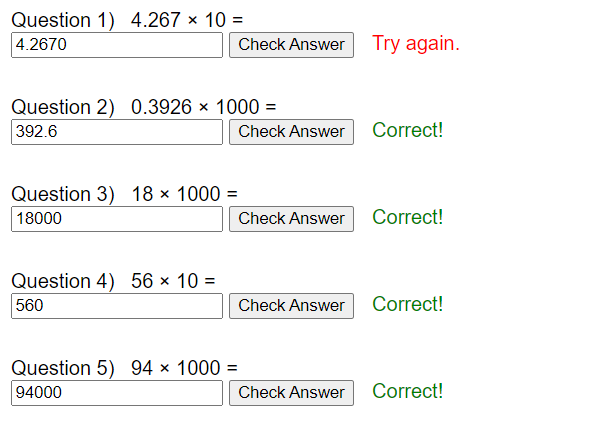
The interactive worksheet below generates questions, gives instant feedback, and lets students record their score.
What you’ll practise
- Multiplying by 10, 100 and 1000.
- Understanding how digits change place value.
- Working with whole numbers and decimals.
- Avoiding the common mistake of just adding zeros.
Use the interactive worksheet below, or read the Topic guide for the method and worked example.
Multiply the following numbers by 10, 100, or 1000.
Topic guide
What this worksheet practises
This worksheet provides practice on multiplying decimal numbers by powers of 10 (10, 100, 1000, etc.). This is a foundational skill for unit conversions and working with standard form. The key is understanding that multiplying by 10 shifts the digits, making the number larger.
Key method
While mathematically the digits move to the left across the place value columns, it is visually much easier to think about moving the decimal point to the right.
- Count the number of zeroes in the power of 10 you are multiplying by (10 has one zero, 100 has two, 1000 has three).
- Take your decimal point and physically jump it to the right by that number of places.
- If you run out of numbers to jump over, you must fill the empty spaces with "placeholder" zeroes.
Worked example
1) Calculate 4.73 × 10.
2) Calculate 0.8 × 1000.
Example 1: (4.73 × 10)
Step 1: 10 has one zero.
Step 2: Move the decimal point one place to the right: 4.73 → 47.3
Final Answer: 47.3.
Example 2: (0.8 × 1000)
Step 1: 1000 has three zeroes.
Step 2: Move the decimal point three places to the right. We only have one digit (the 8) to jump over, so we need two placeholder zeroes.
0.8 → 8 (one jump)
8 → 80 (two jumps)
80 → 800 (three jumps)
Final Answer: 800.
Common mistakes to avoid
The most common mistake is simply "adding zeroes" to the end of a decimal number without moving the point. For example, claiming that 4.73 × 10 = 4.730. Adding a zero to the end of a decimal does not change its value at all; 4.73 is exactly the same size as 4.730. The decimal point must move.
How to check your answer
Always perform a quick magnitude check. If you start with 4.73 (roughly 5), and multiply by 10, your answer should be roughly 50. Our answer of 47.3 fits perfectly. If your answer was 473, you would instantly know you moved the point one place too many.