
Equation of a line connecting two points
The equation of a line connecting two coordinates is a key concept in geometry and algebra. It's used to describe the relationship between two points on a plane. For example, this idea is essential in navigation, computer graphics, and even architecture when designing structures. Understanding how to find this equation allows you to predict how one value changes in relation to another, like plotting a path between two locations on a map! Jump to the questions
Practise now
Worksheet preview and key skills
Worksheet preview
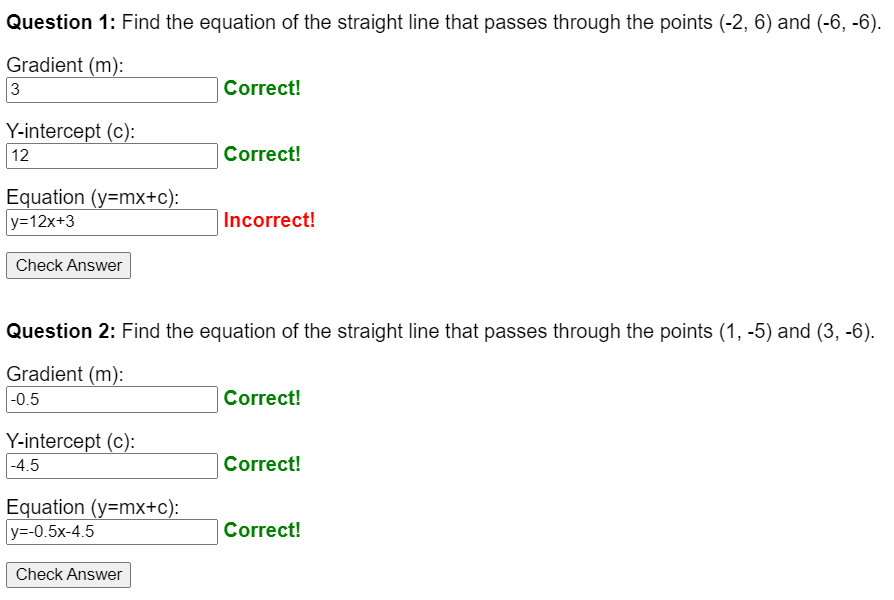
Practise the equation of a line connecting two points with this self-marking maths worksheet.
The interactive worksheet below generates questions, gives instant feedback, and lets students record their score.
What you’ll practise
- Finding the gradient between two points.
- Using one point on the line.
- Substituting into y = mx + c where appropriate.
- Writing the equation of the line.
Use the interactive worksheet below, or read the Topic guide for the method and worked example.
Values should be entered as decimals.
Topic guide
What this worksheet practises
This worksheet focuses on finding the equation of a straight line when you are only given the coordinates of two points on that line. This requires combining two distinct skills: calculating the gradient, and then calculating the y-intercept.
Key method
Every straight line can be written in the form y = mx + c.
- First, calculate the gradient ('m') using the formula: m = (change in y) ÷ (change in x).
- Substitute your calculated 'm' into the equation y = mx + c.
- Pick one of the given points (it doesn't matter which one) and substitute its x and y coordinates into your equation.
- Solve the resulting equation to find 'c' (the y-intercept).
- Write out the final equation using your calculated 'm' and 'c' values.
Worked example
Find the equation of the line that passes through (2, 5) and (4, 11).
Step 1: Calculate the gradient (m).
Change in y = 11 − 5 = 6.
Change in x = 4 − 2 = 2.
m = 6 ÷ 2 = 3. So the equation starts y = 3x + c.
Step 2: Find 'c' by substituting one point. Let's use (2, 5). Here, x=2 and y=5.
5 = 3(2) + c
5 = 6 + c
c = 5 − 6 = −1.
Step 3: Write the full equation.
y = 3x − 1.
Common mistakes to avoid
The most common error is calculating the gradient upside down (doing change in x divided by change in y). Always remember "rise over run": the y-values (the rise) must always be on the top of the fraction.
How to check your answer
You can easily check your final equation by substituting the other coordinate point into it. If our equation is y = 3x − 1, let's test the second point (4, 11). If x is 4, then y = 3(4) − 1 = 12 − 1 = 11. This matches the point perfectly, proving the equation is correct.