
Percentage change
We often use percentage change to compare how much something has increased or decreased over time — like the rise in food prices, the drop in fuel costs, or changes in your test scores. It’s a quick way to see how big a change really is, no matter what the original amount was. Jump to the questions
Practise now
Worksheet preview and key skills
Worksheet preview
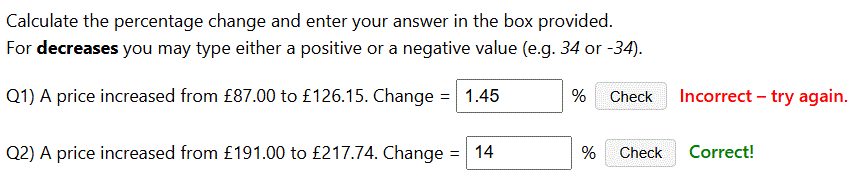
Practise percentage change with this self-marking maths worksheet.
The interactive worksheet below generates questions, gives instant feedback, and lets students record their score.
What you’ll practise
- Finding the amount of increase or decrease.
- Dividing the change by the original value.
- Multiplying by 100 to find the percentage change.
- Deciding whether the result is an increase or decrease.
Use the interactive worksheet below, or read the Topic guide for the method and worked example.
Calculate the percentage change and enter your answer in the box provided.
For decreases you may type either a positive or a negative value
(e.g. 34 or -34).
Topic guide
What this worksheet practises
This worksheet focuses on calculating the percentage change between two values. This is useful for comparing how much a price has increased, or how much a population has decreased, relative to its original size.
Key method
To find a percentage change (either an increase or a decrease), you can use a straightforward formula:
Percentage Change = (Actual Change ÷ Original Amount) × 100
- Find the actual change by subtracting the old value from the new value (or vice versa to find the positive difference).
- Divide this difference by the original starting amount.
- Multiply the result by 100 to convert it into a percentage.
Worked example
A pair of shoes originally cost £40. The price is increased to £50. Calculate the percentage increase.
Step 1: Calculate the actual change in price.
£50 − £40 = £10
Step 2: Divide the change by the original amount.
10 ÷ 40 = 0.25
Step 3: Multiply by 100.
0.25 × 100 = 25%
The price has increased by 25%.
Common mistakes to avoid
The most common mistake is dividing by the new amount instead of the original amount. In the example above, dividing 10 by 50 gives 20%, which is incorrect. Always double-check that your denominator is the starting value.