
Perimeter of compound rectangles
Ever tried figuring out how much fencing you need for an L-shaped garden or the trim for an oddly laid-out picture frame? That’s the perimeter of compound rectangles in action—adding up the edges of several joined rectangles so you know exactly how far your materials (and money!) have to stretch. Jump to the questions
Practise now
Worksheet preview and key skills
Worksheet preview
Practise perimeter of compound rectangles with this self-marking maths worksheet.
The interactive worksheet below generates questions, gives instant feedback, and lets students record their score.
What you’ll practise
- Tracing the outside edges of the compound rectangle.
- Finding missing side lengths from opposite sides.
- Adding all outer side lengths.
- Giving the perimeter with suitable units.
Use the interactive worksheet below, or read the Topic guide for the method and worked example.
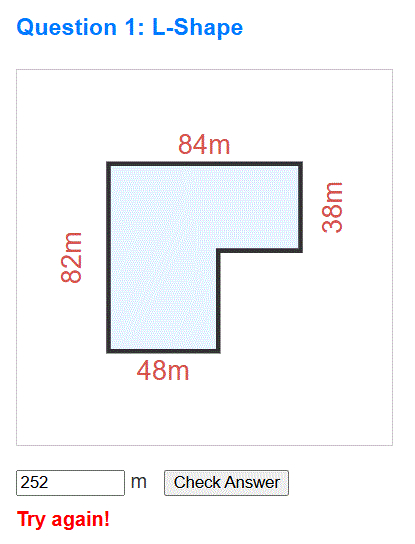
For each shape below, determine its perimeter using the given side lengths. Not all sides are labeled.
Topic guide
What this worksheet practises
This worksheet provides practice on calculating the perimeter of compound shapes (L-shapes or T-shapes made by joining rectangles together). The major challenge is that exams rarely give you all the side lengths; you must use parallel lines to deduce the missing measurements before you can calculate the perimeter.
Key method
You must find the missing sides before you can add the perimeter together.
- Find missing vertical sides: Look at all the vertical lines. The longest vertical line is always equal in length to the sum of the shorter vertical lines parallel to it. (e.g. Left side = Right side top + Right side bottom).
- Find missing horizontal sides: Look at all the horizontal lines. The longest horizontal line is always equal in length to the sum of the shorter horizontal lines parallel to it. (e.g. Top side = Bottom side left + Bottom side right).
- Use subtraction to find a missing short side, or addition to find a missing long side.
- Once every single side is labelled, trace your finger around the outside and add them all up.
Worked example
An L-shape has a total left height of 10cm and a total bottom width of 12cm. The top horizontal cut-out is 5cm wide, and the bottom-right vertical cut-out is 4cm high. Find the perimeter.
Step 1: Find the missing horizontal side (the inner bottom ledge).
Total width is 12. Top width is 5. The missing ledge is 12 − 5 = 7cm.
Step 2: Find the missing vertical side (the inner top drop).
Total height is 10. The lower right height is 4. The missing drop is 10 − 4 = 6cm.
Step 3: Check all 6 sides of the L-shape are now labelled (10, 5, 6, 7, 4, 12).
Step 4: Add them all together.
10 + 5 + 6 + 7 + 4 + 12 = 44.
The perimeter is 44cm.
Common mistakes to avoid
The most common mistake is simply adding up the numbers given in the diagram without finding the missing sides first. If an L-shape has 6 sides, you must add 6 numbers together. Never assume a side is a certain length just because it "looks" like it is half the size of another.
Things to remember
There is a clever shortcut for L-shapes. If you imagine "pushing" the inner horizontal and vertical lines outwards to fill in the missing corner, the L-shape becomes a perfect large rectangle. Therefore, the perimeter of an L-shape is exactly the same as the perimeter of the large bounding rectangle that encloses it. In our example: 10 + 12 + 10 + 12 = 44cm.