
Percentage increases and decreases
Percentage increases and decreases are everywhere in real life — from spotting discounts in shops to calculating interest on savings, or even tracking changes in population or prices. Understanding how they work helps you make smarter decisions with money, data, and everyday comparisons. Jump to the questions
Practise now
Worksheet preview and key skills
Worksheet preview
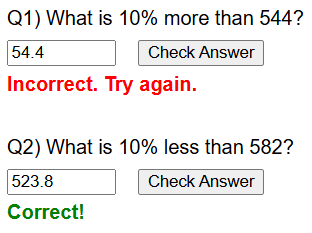
Practise percentage increases and decreases with this self-marking maths worksheet.
The interactive worksheet below generates questions, gives instant feedback, and lets students record their score.
What you’ll practise
- Identifying whether the value increases or decreases.
- Finding the percentage amount.
- Adding or subtracting the change.
- Calculating the final value.
Use the interactive worksheet below, or read the Topic guide for the method and worked example.
Topic guide
What this worksheet practises
This worksheet provides practice on increasing or decreasing a starting amount by a given percentage. This is the mathematical process behind store discounts, sales tax, pay rises, and depreciation.
Key method
You can do this by calculating the percentage first and then adding/subtracting it, or by using a single multiplier (the faster method).
- Method 1 (Two-step): Calculate the percentage of the amount. If it is an increase, add this value to the original amount. If it is a decrease, subtract it from the original amount.
- Method 2 (Multiplier): Start with 100%. If it is an increase, add the percentage to 100 (e.g. an 8% increase means you want 108% of the original). If it is a decrease, subtract it from 100 (e.g. a 20% decrease means you want 80% of the original). Turn this new percentage into a decimal multiplier, and multiply your starting amount by it.
Worked example
1) Increase £40 by 15%.
2) Decrease 300kg by 12%.
Example 1 (Increase):
Multiplier method: 100% + 15% = 115%. As a decimal, this is 1.15.
40 × 1.15 = £46.
Example 2 (Decrease):
Multiplier method: 100% − 12% = 88%. As a decimal, this is 0.88.
300 × 0.88 = 264kg.
Common mistakes to avoid
When calculating a decrease, the most common error is calculating the percentage and stopping. For example, to decrease £50 by 10%, a student calculates 10% is £5, and writes £5 as the final answer. You must remember the final step: 50 − 5 = £45.
Things to remember
When using the multiplier method, an increase multiplier will always start with "1." (e.g. 1.20). A decrease multiplier will always start with "0." (e.g. 0.80).