
Substitution - multiplication and indices
Algebraic substitution is a handy technique used to simplify complex expressions or solve equations by replacing variables with numbers or other expressions. You’ll often use it in real-world situations like calculating costs, predicting outcomes, or solving puzzles where one value depends on another. Jump to the questions
Looking for easier substitution problems?
Practise now
Worksheet preview and key skills
Worksheet preview
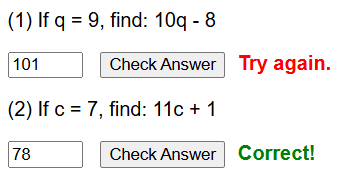
Practise substitution with multiplication and indices with this self-marking maths worksheet.
The interactive worksheet below generates questions, gives instant feedback, and lets students record their score.
What you’ll practise
- Substituting values into expressions.
- Evaluating powers before multiplication where appropriate.
- Using order of operations.
- Calculating the final value.
Use the interactive worksheet below, or read the Topic guide for the method and worked example.
Practice algebraic substitution across linear, quadratic, and cubic expressions.
Topic guide
What this worksheet practises
This worksheet provides practice on advanced algebraic substitution, specifically dealing with negative numbers, hidden multiplication, and indices (powers) all in the same expression. This strictly tests your application of BIDMAS.
Key method
The golden rule of substitution is to put brackets around every single number you substitute into the formula.
- Identify the given numerical values for the letters (e.g. x = −2, y = 5).
- Rewrite the entire expression, replacing every letter with its number inside brackets. (e.g. 4xy² becomes 4(−2)(5)²).
- Indices First: Calculate any powers. Only square the number directly attached to the power.
- Multiplication Second: Multiply the numbers together. Remember that a number outside a bracket means multiply.
- Addition/Subtraction Last: Combine the final terms.
Worked example
Find the value of 3a²b when a = −4 and b = 2.
Step 1: Substitute the numbers using brackets.
3(−4)²(2)
Step 2: Indices first. We must calculate (−4)².
(−4) × (−4) = +16.
The expression is now: 3(16)(2)
Step 3: Multiplication next. Everything touching means multiply.
3 × 16 = 48.
48 × 2 = 96.
The final answer is 96.
Common mistakes to avoid
The most common and destructive mistake is failing to use brackets when squaring a negative number on a calculator. If you type -4², the calculator will say -16 (because it squares the 4 first, then makes it negative). You must type (-4)² to get the correct answer of +16.
Things to remember
In the expression 3a², the square only applies to the 'a'. It does NOT apply to the 3. You do not square the 3. However, if the expression was written as (3a)², the brackets mean the square applies to the entire thing inside, meaning you would have to square the 3 as well.