
Perimeter and area of squares and rectangles
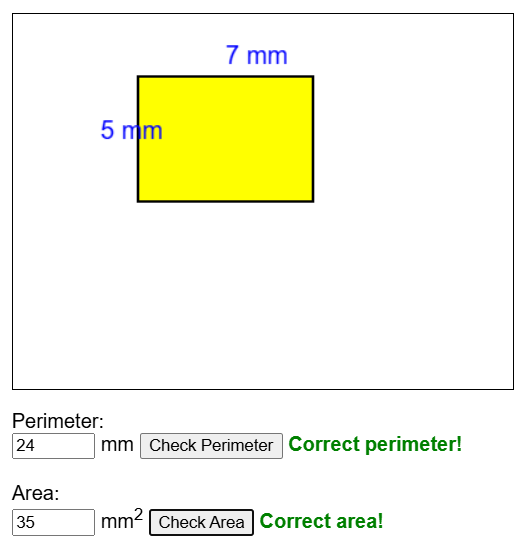
The area and perimeter of rectangles are essential concepts in geometry, often used in real life when designing rooms, fences, gardens, or even packaging. The perimeter tells us the total distance around the rectangle, while the area helps us understand how much space it covers. Whether you're laying tiles or building a sports field, knowing how to calculate these measurements is a valuable skill! Jump to the questions
Practise now
Worksheet preview and key skills
Worksheet preview
Practise perimeter and area of squares and rectangles with this self-marking maths worksheet.
The interactive worksheet below generates questions, gives instant feedback, and lets students record their score.
What you’ll practise
- Distinguishing perimeter from area.
- Using length × width for area.
- Adding all sides or using 2l + 2w for perimeter.
- Using the correct units for length or area.
Use the interactive worksheet below, or read the Topic guide for the method and worked example.
Enter the correct values for the area and perimeter of each shape.
Topic guide
What this worksheet practises
This worksheet provides essential practice on calculating both the area and perimeter of basic squares and rectangles. Confusing these two distinct measurements is one of the most common errors in foundation geometry.
Key method
Perimeter is the total length of the outside boundary. Area is the amount of flat 2D space inside the shape.
- Perimeter: Trace your finger around the outside of the shape. Add up the lengths of all four sides. If only two sides of a rectangle are labelled, you must remember that the opposite sides are identical in length. The units will be normal lengths (cm, m).
- Area: Multiply the base length by the vertical height (Area = base × height). The units will be squared (cm², m²).
Worked example
A rectangle has a base of 8cm and a height of 5cm. Calculate its area and perimeter.
Step 1 (Area): Multiply the base by the height.
Area = 8 × 5 = 40.
The area is 40 cm².
Step 2 (Perimeter): Add up all four sides.
The sides are 8, 5, and the two opposite hidden sides are also 8 and 5.
Perimeter = 8 + 5 + 8 + 5 = 26.
The perimeter is 26 cm.
Common mistakes to avoid
The most devastating mistake is calculating the area when asked for the perimeter, or vice versa. Always double-check which one you are being asked for. The second most common error is calculating perimeter by only adding the two visible labelled sides together (e.g. 8 + 5 = 13), forgetting the two unmarked sides of the rectangle.
Things to remember
If you are given a square and only one side length is written (e.g. 6cm), you know everything you need. Because it is a square, all four sides are exactly 6cm long. The perimeter is 6 + 6 + 6 + 6 (or 24), and the area is 6 × 6 (or 36).