
Probability scales
A probability scale is a visual way to show how likely an event is to happen. It runs from impossible at one end to certain at the other. This interactive worksheet practises placing different mathematical events correctly onto a stepped 0 to 1 scale. Understanding probability scales is incredibly useful in real life, helping us to analyse risk, evaluate fairness in games, and confidently interpret the chance of different outcomes in experiments. Jump to the questions
Practise now
Worksheet preview and key skills
Worksheet preview
Practise using probability scales with this self-marking maths worksheet.
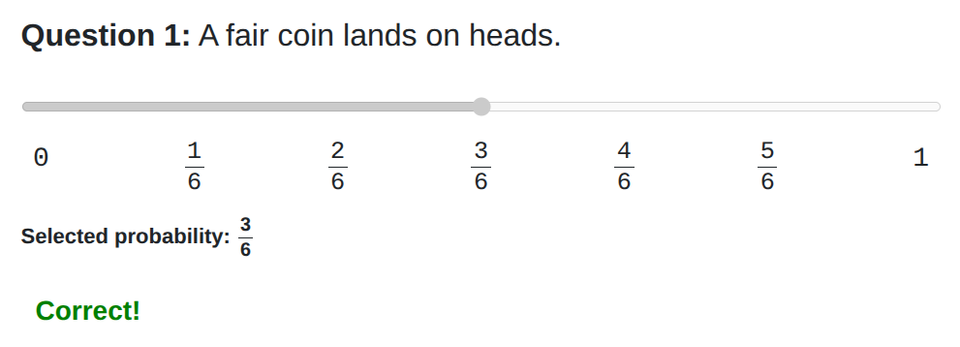
The interactive worksheet below asks students to place events on a probability scale from 0 to 1, using questions about coins, dice, impossible events and certain events.
What you’ll practise
- Reading a probability scale from 0 to 1.
- Placing events on a scale divided into sixths.
- Finding probabilities for fair coins and normal six-sided dice.
- Identifying impossible, equally likely and certain events.
Use the interactive worksheet below, or read the Topic guide for the method and worked example.
Move the slider to show the probability of each event on the scale from 0 (impossible) to 1 (certain).
Topic guide
What is a probability scale?
A probability scale is a number line that shows the chance of an event happening. It always runs from 0 to 1.
- 0 means impossible. There is no chance the event will happen.
- 1 means certain. The event is definitely going to happen.
- 1/2 means equally likely. There is an even chance of the event happening or not happening.
Probabilities on the scale can be written as fractions (like 1/2), decimals (like 0.5), or percentages (like 50%).
Using sixths and simplified fractions
In this worksheet, the probability scale is divided into six equal parts to match a six-sided die. It uses sixths consistently to make comparing probabilities easier.
However, remember that these sixths can be simplified into common equivalent fractions:
- 3/6 is equivalent to 1/2
- 2/6 is equivalent to 1/3
- 4/6 is equivalent to 2/3
Key method
To place an event accurately on a probability scale, you need to calculate its probability first. Think about the total number of possible outcomes and the number of favourable outcomes (the ones you want to happen).
For example, when rolling a normal, fair six-sided die, there are 6 possible outcomes (1, 2, 3, 4, 5, or 6). To find the probability of a specific result, count the favourable outcomes out of 6.
Worked example
Question: Where would you place the event "rolling a number less than 5 on a normal six-sided die" on a probability scale?
- Step 1: Identify favourable outcomes. The numbers less than 5 on a die are 1, 2, 3, and 4. That gives us 4 favourable outcomes.
- Step 2: Identify total outcomes. There are 6 possible outcomes in total.
- Step 3: Write the probability. The probability is 4/6.
- Step 4: Simplify and place. 4/6 simplifies to 2/3, but on a scale divided into sixths, you can simply place this event at the 4/6 mark along the scale from 0 to 1.
Useful tips
- For a fair coin, there are 2 outcomes (heads or tails). The probability of getting heads is exactly 1/2 (which is 3/6).
- Remember your special number types! When working with dice, remember that 2, 3, and 5 are prime numbers; 1 and 4 are square numbers; and 2, 4, and 6 are even numbers.
Common mistakes to avoid
- Confusing "unlikely" with "impossible". An event is only impossible if the probability is exactly 0. If it has a tiny chance of happening, it is unlikely, but not impossible.
- Confusing "likely" with "certain". An event is only certain if the probability is exactly 1. No matter how sure you feel, if there is a tiny chance it might not happen, it is not certain.
- Going past 1. Probabilities can never be greater than 1 (or 100%). If your calculation gives you a number bigger than 1, check your working!
Quick check
Before you begin the worksheet, ask yourself: what is the probability of a normal six-sided die landing on 7? (Answer: 0, because it is impossible!)