
Probability trees - dependent events
Probability trees are an excellent tool for modelling dependent events, where the outcome of the first event changes the probability of the second. A common example is picking items from a bag without replacing them. This interactive worksheet lets you practise completing dependent probability trees using fractions, and then calculate combined outcomes. Jump to the questions
Looking for questions on independent events?
Practise now
Worksheet preview and key skills
Worksheet preview
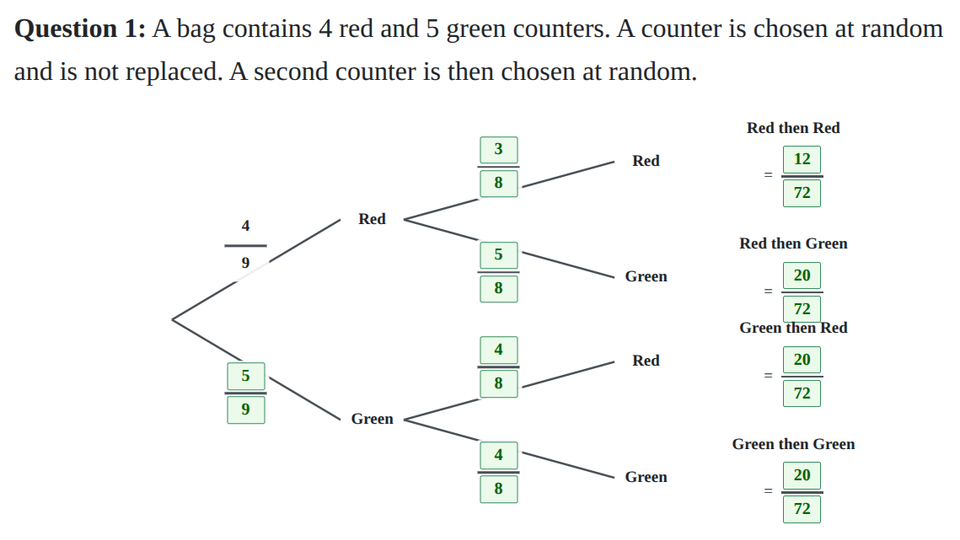
This worksheet tests your ability to complete probability trees for dependent events.
You will be presented with a scenario where an object is chosen without replacement, altering the probabilities for the second choice.
What you’ll practise
- Identifying dependent events and selection without replacement.
- Completing branch probabilities as fractions.
- Calculating the changing second-stage probabilities.
- Multiplying fractions along branches to find path outcomes.
- Adding combined fraction outcomes where appropriate to answer specific questions.
Use the interactive worksheet below, or read the Topic guide for the method and worked example.
Topic guide
Dependent events occur when the outcome of one event affects the probabilities of the next event. A classic example is picking items from a container without replacement.
Why probabilities change without replacement
If you select an object and do not replace it:
- The total number of objects left in the container decreases by 1 (the denominator).
- The number of objects of the selected colour also decreases by 1 (the numerator).
Because the contents have changed, the probabilities for the second selection will be different from the first. This is unlike selection with replacement, where the contents return to their original state and the probabilities remain the same.
How to complete the second branches of a probability tree
Consider a bag with 3 red and 4 blue counters. A counter is chosen at random and is not replaced. A second counter is then chosen.
For the first choice, there are 7 counters in total:
- P(red) = 3/7
- P(blue) = 4/7
If the first counter was red, the bag now contains 2 red and 4 blue counters (6 in total). The second set of branches after choosing red will be:
- P(red) = 2/6 = 1/3
- P(blue) = 4/6 = 2/3
If the first counter was blue, the bag now contains 3 red and 3 blue counters (6 in total). The second set of branches after choosing blue will be:
- P(red) = 3/6 = 1/2
- P(blue) = 3/6 = 1/2
Note: Equivalent fractions represent the same probability. Answering 2/6 or 1/3 is mathematically correct.
Multiplying probabilities along a path
To find the probability of a combined outcome, multiply the fractions along the path that leads to it.
For example, the probability of choosing red then blue is:
P(red, blue) = 3/7 × 4/6 = 12/42 = 2/7
Adding suitable outcomes
To find the probability of multiple outcomes, add the probabilities of the valid paths.
For example, the probability of choosing one of each colour is the sum of P(red, blue) and P(blue, red).
(3/7 × 4/6) + (4/7 × 3/6) = 12/42 + 12/42 = 24/42 = 4/7
Common mistakes
- Forgetting to decrease the total number of items (the denominator) by 1 for the second choice.
- Copying the first-stage probabilities to the second-stage branches instead of calculating the new values.
- Adding along paths instead of multiplying.
Things to remember
- Always check the wording carefully to see if the item is replaced or not.
- Without replacement, both the total count and the count of the selected item decrease by 1 for the second choice.
- Probabilities on each pair of branches must always sum to 1.